Did Ratzinger's hand stop Bergoglio's opening on celibacy?
Cardinal Fernández told Corriere della Sera that Francis, on married priests, “wanted to take that decision,” but held back to avoid “internal conflicts.” The dates in 2020 suggest a role for Benedict XVI. Official sources do not confirm it.
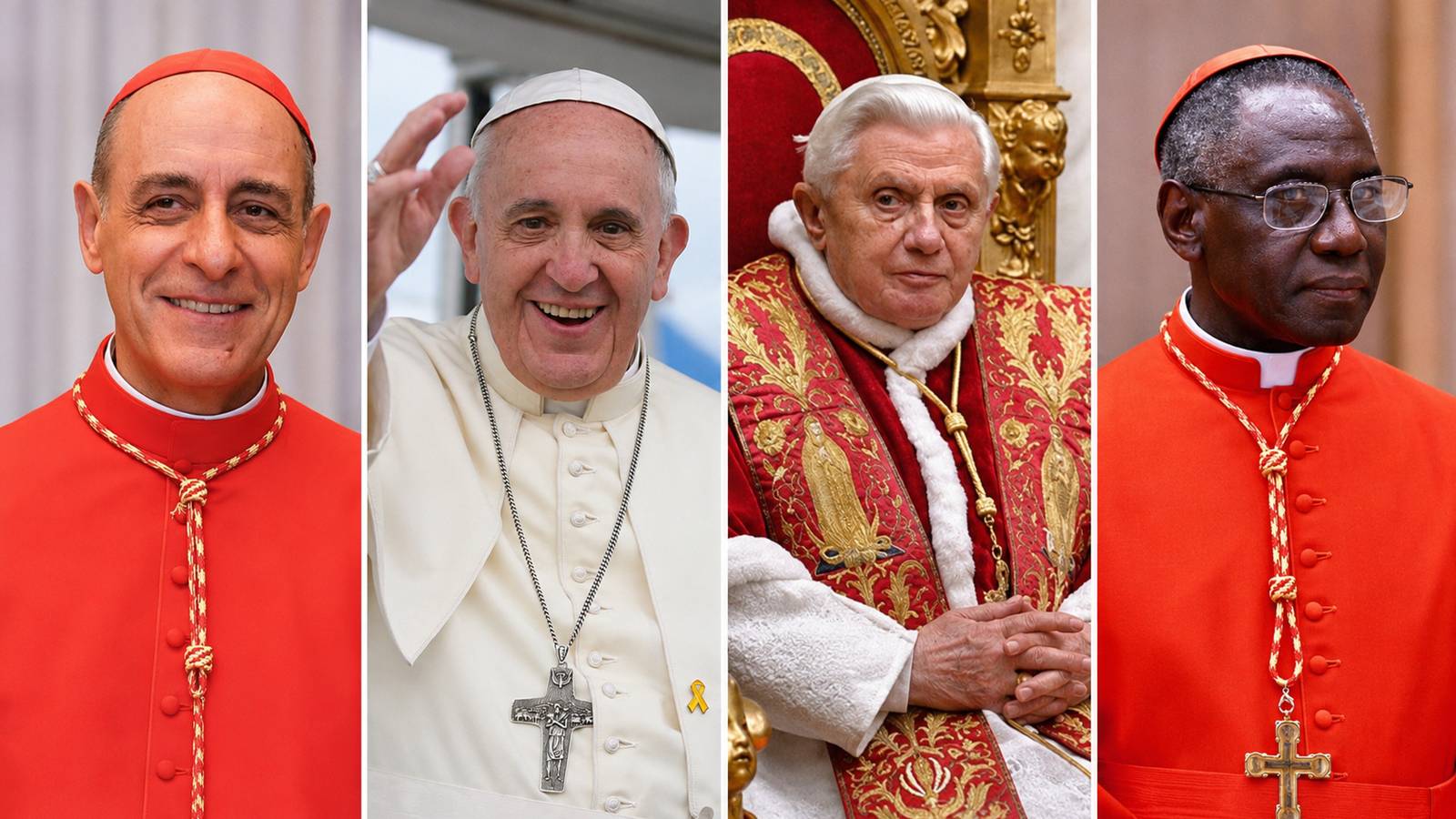
On 24 November 2026, presenting The Personal Diary of Pope Francis, Cardinal Víctor Manuel Fernández, prefect of the Dicastery for the Doctrine of the Faith, answered a question from [Aldo Cazzullo in Corriere della Sera](https://www.corriere.it/cronache/26_novembre_24/papa-francesco-diavolo-diario-cardinale-fernandez-e33cecb6-52e9-4135-a65b-dbbc29649xlk.shtml). The journalist asked whether Francis would not have done better to take “clear-cut decisions, for example on the possibility of ordaining married men as priests.” Fernández replied: “He wanted to take that decision. But he wanted to avoid internal conflicts, verbal violence. When we prepared the document allowing blessings for same-sex couples there was a very harsh reaction…” (our translation).
The remark has revived a question that already ran through the Church in January and February 2020: did Benedict XVI’s public intervention weigh on that choice? The facts and the hypothesis need to be kept apart.
The record, 2019-2020.
From 6 to 27 October 2019 the Special Assembly of the Synod of Bishops for the Pan-Amazon Region met at the Vatican. The final document, voted on 26 October, said in paragraph 111 — approved by 128 placet and 41 non placet, the highest number of votes against in the assembly, but still above a two-thirds majority — that “the competent authority” should “establish criteria and provisions” to ordain as priests “suitable and recognised men of the community, who have a fruitful permanent diaconate and receive an adequate formation for the presbyterate, even if they have a legitimately constituted and stable family,” in order to support communities “in the most remote areas of the Amazon region.” The term viri probati does not appear in the text; the proposal concerns men who are already permanent deacons, with a stable family, for the most isolated areas. The vote is recorded in the Holy See Press Office Bulletin.
In mid-January 2020, while the post-synodal exhortation was still awaited, Fayard published in France Des profondeurs de nos cœurs, issued in English as From the Depths of Our Hearts and in Italian by Cantagalli as Dal profondo del nostro cuore. The book, by Cardinal Robert Sarah, then prefect of the Congregation for Divine Worship, includes a contribution from Benedict XVI in defence of priestly celibacy. The first French edition is dated 15 January 2020; excerpts and a cover bearing both names were already circulating in the days before.
On 14 January 2020 Archbishop Georg Gänswein, prefect of the Papal Household and personal secretary of the Pope emeritus, issued a statement to the KNA and ANSA news agencies, reported by Vatican News. “I can confirm that this morning, at the indication of the Pope emeritus, I asked Cardinal Robert Sarah to contact the publishers of the book requesting them to remove the name of Benedict XVI as co-author of the book itself, and also to remove his name from the introduction and conclusions.” Gänswein added that the Pope emeritus “knew the Cardinal was preparing a book and had sent a short text of his on the priesthood,” authorising him to use it as he wished. But he “had not approved any project for a co-signed book, nor had he seen and authorised the cover. It was a misunderstanding, without questioning the good faith of Cardinal Sarah.”
The same day Sarah announced that, “given the controversy,” the author would be given as “Card. Sarah with a contribution from Benedict XVI.” The text, he said, remained “absolutely unchanged.” The disagreement was over the form of the signature — not over the content of Ratzinger’s essay.
The post-synodal apostolic exhortation [Querida Amazonia](https://www.vatican.va/content/francesco/en/apost_exhortations/documents/papa-francesco_esortazione-ap_20200202_querida-amazonia.html), signed on 2 February and published on 12 February 2020, did not open the way to the ordination of married men. Francis does not explicitly reject paragraph 111: he simply does not mention it. He restates that only those who have received Holy Orders can preside at the Eucharist and grant sacramental absolution, and he asks bishops, especially in Latin America, to encourage priestly missions in the most remote areas.
The hypothesis, and those who played it down.
The link between the book and the exhortation is a hypothesis, not an established fact. The dates are close: the volume appears in mid-January, Querida Amazonia on 12 February. In recent days the Polish Catholic site PCh24 and the journalist Paweł Chmielewski have pressed this sequence, connecting Francis’s holding back also with Benedict XVI’s essay. PCh24 itself, however, acknowledges that Fernández, in his conversation with Cazzullo, does not confirm that link. The prefect speaks of “internal conflicts” and “verbal violence,” and draws a parallel with the reactions to Fiducia supplicans. He does not name Ratzinger, or Sarah, or the book.
Other observers, already on 12 February 2020, ruled out or played down the book’s influence. Gerard O’Connell, in [America](https://www.americamagazine.org/faith/2020/02/12/whats-pope-francis-apostolic-exhortation-amazon-synod/), wrote that the decision not to address the viri probati “was not at all influenced by the Cardinal Sarah book to which Benedict XVI contributed, because as America learned Francis had already completed his exhortation on Dec. 27, weeks before anyone even knew of the existence of that work, except those directly involved.” The National Catholic Reporter, the same day, reported that “several well-informed sources” had said the document “had been substantially finished in late December,” well before the book was announced, while warning that the timing of the release might still feed speculation. In later reconstructions Archbishop Gänswein denied that the book had been intended to put pressure on Francis.
There is, above all, an explanation from Francis himself, later than the exhortation and independent of that hypothesis. On 5 September 2020 Fr Antonio Spadaro published in [La Civiltà Cattolica](https://www.laciviltacattolica.it/articolo/il-governo-di-francesco/) an essay, “Il governo di Francesco,” quoting a personal note the Pope had wished to share. On the priestly ordination of viri probati at the Amazon Synod, Francis wrote: “There was a discussion… a rich discussion… a well-founded discussion, but no discernment, which is something different from arriving at a good and justified consensus or at relative majorities.” And he went on: “We must understand that the Synod is more than a Parliament; and in this specific case it could not escape that dynamic. On this subject it was a rich, productive and even necessary Parliament; but no more than that. For me this was decisive in the final discernment, when I thought about how to write the Exhortation” (our translation). Spadaro commented that, if the conditions are lacking, the Pope “simply does not proceed, without however denying the validity of the proposals,” and leaves the discussion open. In those notes Francis does not mention Sarah’s book or Benedict XVI.
The question remains open.
What remains, side by side, is a new fact and an old question. The fact is Fernández’s testimony: Francis, on married priests, “wanted to take that decision,” and held back “to avoid internal conflicts, verbal violence.” The question is whether, among those resistances, “Ratzinger’s hand” also counted. The dates in 2020 make it conceivable. The primary sources — the Corriere interview, the exhortation, the notes to Spadaro, America’s report that the text was finished on 27 December — do not prove it. Fernández does not put it that way. When Francis explained his own choice, he spoke of discernment, not of a book.
Did Ratzinger’s hand stop Bergoglio’s opening on celibacy?
#PopeFrancis #BenedictXVI #Vatican
Source: Corriere della Sera