

Francis's Diary: «I am afraid», visions of the devil and a spiritual crisis
Cardinal Fernández's book with Bergoglio's notes from 1992 to 2024 is out today: fears, three visions of the devil, the 2021-2022 crisis and the two documents that grew from it. Leo XIV found the box with the texts and approved the publication.
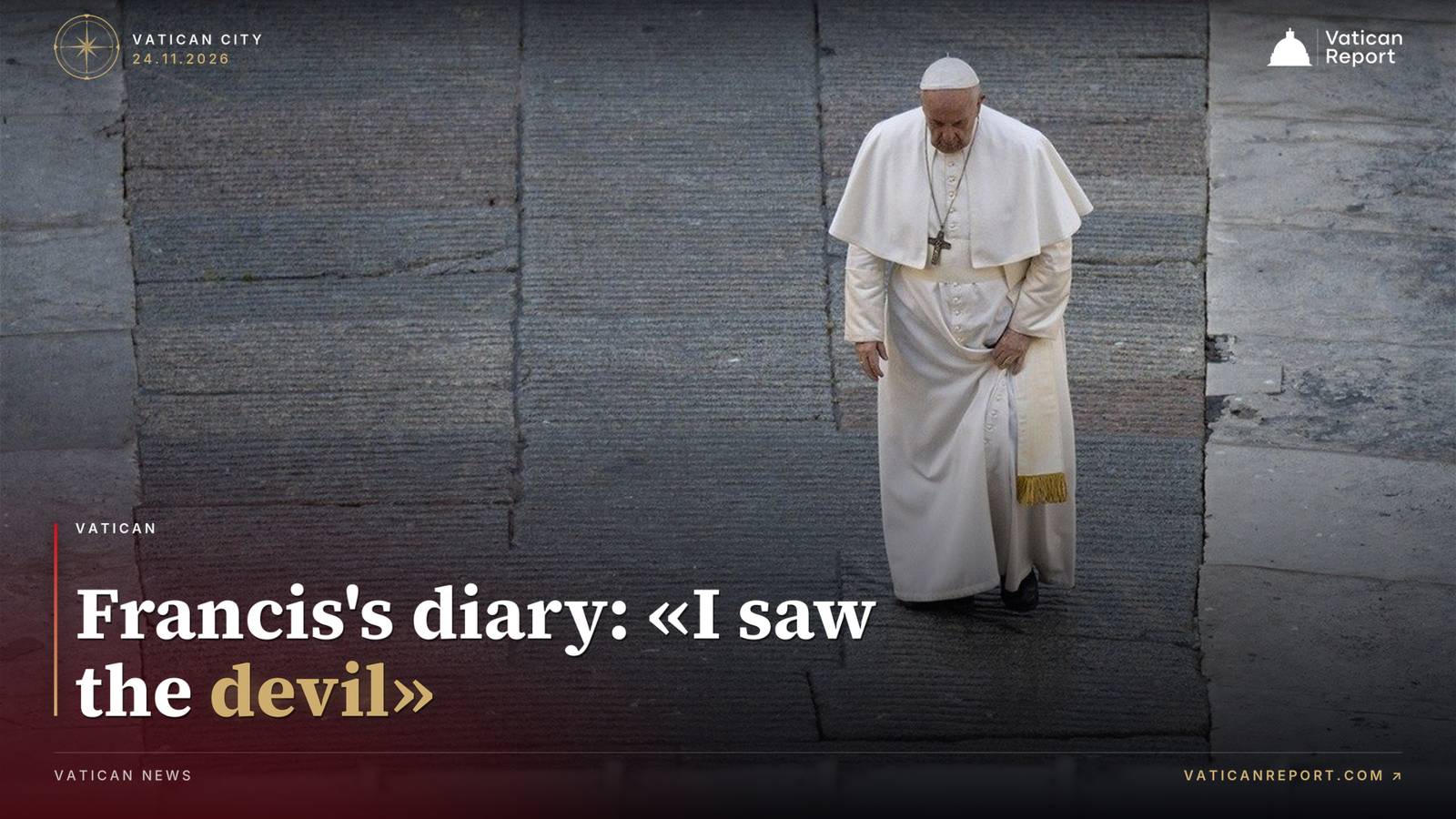
The Personal Diary of Pope Francis, published today, 24 November, by the Vatican Publishing House, is the book in which Cardinal Víctor Manuel Fernández, prefect of the Dicastery for the Doctrine of the Faith, presents and comments on notes kept by Jorge Mario Bergoglio from 20 December 1992 to 18 August 2024. It is not a literary diary: it is a planner with a black plastic cover, the one from his Buenos Aires years, later kept at Santa Marta, in which the Jesuit Pope – who died on 21 April 2025 – jotted down, «in small, slanted handwriting», his fears, his judgments about himself, spiritual visions and an inner crisis lasting two years of his pontificate.
The volume is released worldwide in five languages and 94 countries: in Italian by LEV, in Spanish, English and Portuguese by Penguin Random House, and in French by Éditions Albin Michel. Vatican News speaks of about 160 pages; Il Foglio, which published an extract, lists the Italian LEV edition at 176 pages (16 euros). The book will be presented on Saturday 28 November in Milan, at BookCity, in the church of San Fedele at 5 p.m.
How the book came about. Fernández himself recounts the origin of the volume in an interview conducted by Andrea Tornielli. One afternoon at Santa Marta, beside Francis's personal desk – one of his secretaries was in the next room – the two men were speaking privately about the possibility of preparing a document on what to do if the Pope were to lose consciousness irreversibly. That text, the cardinal says, «did not go ahead». In that context Francis pointed out a place where he kept three documents and an appointment book. Fernández saw that the documents had been underlined and, when he opened the appointment book, realized it was being used «as a sort of diary», though he «did not manage to read anything». Francis told him: «You others will see about this». Of the rest the cardinal remembers only the expression «whatever is for edification»: he asked him, when the time came, to choose what might be of use to people.
After Leo XIV's election, Fernández says, he did not want to bother him; «after a few months» he began to worry about where that material might end up, «whose hands it might fall into, if it did not disappear altogether». He therefore went to tell the new Pope about that conversation and the mandate he felt obliged to carry out. Leo XIV, he says, «showed an interest, and two days later he found the box containing all the texts», sent it to him immediately and «agreed with everything», including the contextual comments: publishing «the texts alone», the Pope believed, «could confuse readers who did not know Francis well». The work, Cernuzio reports, was completed «after a year».
The book, Fernández explains, is arranged by subject and «contains everything worthwhile, even some very provocative and unsettling things, without hiding anything». All that is missing are «a few phrases that add nothing or are repetitive», «paragraphs about private matters concerning living people», and «many parts written in strange signs, like hieroglyphics», which the cardinal believes must be respected. When he opened the box, he says, he was «surprised» and «shocked»: not gossip, but «facts essential to a firsthand understanding of Francis as a person and of his soul».
The edition and the Vatican Publishing House. The official announcement came on 5 October from the Vatican Publishing House and Vatican News. Andrea Tornielli, editorial director of the Dicastery for Communication, said: «With this book […] we will be able to know even more the interiority of the Argentine Pontiff». Vatican News describes Fernández as a «longtime friend», called from Argentina to Rome in 2023 to lead the Dicastery for the Doctrine of the Faith. In Corriere della Sera, the cardinal points out that he is not «a childhood friend, as many say»: his «intimate» knowledge of Bergoglio, he says, began in 2007, at the Aparecida assembly.
«I am afraid»: the man, not only the Pope. If the book is read without «sensationalism or voyeurism», Cernuzio writes, what stands out is «God's work in the life of a believer». Francis wrote a terse «I am afraid», referring to his fear that he was unequal to his role or might «do harm» to others, even asking the Lord to take him «away» instead. The notes also reveal «fatigue» and health problems dating back to the 1990s, set aside for pastoral «dedication». In the Corriere interview, Fernández mentions minute notes – «I did not greet that lady quite properly when she left»; «I forgot to visit someone who was ill» – and observes that «he was very sensitive to any failing toward people».
Death, according to ANSA, «did not frighten him»: he accepted it and offered it for others. «For Bergoglio it was a little harder to accept old age». The Diary, also previewed today by Corriere and Repubblica, includes thoughts about his family, «especially his parents and grandmothers», and about acquaintances who had lost a relative. An entry of 21 July 2013, reported by ANSA and visible in a Vatican News page, is terse: «On 13 March they elected me Pope». Another, dated 12 February 2013, reads: «Yesterday the Pope resigned».
Three visions of the devil. «I saw the devil», Francis wrote. In Vatican News, Cernuzio reports two episodes: once «from the car» and another time «in the choir area» during Mass, and «his menacing eyes», which Francis could not forget. The last entry, dated 18 August 2024 and published by Il Foglio, sets them within a brief review of his whole life:
«In a brief journey through my life I have seen the times when the devil made himself present. I cannot forget his eyes the first two times: from the car, when I was going home, and in the choir during Mass. Yet he always reappears through various situations; he is a presence lying in wait to intervene, and he does so in different ways, for example by playing the fool or the distracted one. I felt the Lord's invitation to be more attentive and more prudent, and not to allow that presence. I ask the Virgin to take care of me and to help me».
After that date, Fernández says, «he no longer felt the need to add anything else». It was less than a year before his death. The more detailed account is in an entry of 24 January 2021, published by Il Foglio as an extract and read by the cardinal to Corriere (page 53). Francis writes that he had discovered «that the devil had been prowling brazenly, with cunning», and that he remembered «three certain episodes in which I have no doubt that he appeared physically». The first, «about 15 years ago», when he was Archbishop of Buenos Aires: «I saw him from the car window. I cannot forget his menacing and at the same time seductive eyes». The second, «at the celebration in the chapel of the Carmel»: «He looked at me with eyes of fire. I cannot forget that gaze, stronger than the previous one. They were like rays of fire. Then he tried to come closer and I fled, clutching the Rosary and asking the Virgin… Curiosity was struggling with the Rosary. And the Virgin saved me». They were not, he specifies, «compromising situations or temptations, but a fascinating presence, which invited curiosity». And he adds, underlining the words: «There is a weakness here».
The third episode took place on his return from the 2018 journey to Chile, «a few days after my arrival in Rome, during a meeting»: «I saw him and heard his voice, triumphant, master of everything: “Now I have obtained everything I wanted”». «Just as I cannot forget the eyes of the two previous occasions, in this case I cannot forget the powerful rattle of his voice. The Lord gave me the opportunity to leave that meeting and thus I was set free». In the same context, according to the extract, he adds: «But there is something that has remained, like an imprint».
ANSA also reports a 24 January 2021 note on the «Chilean situation» and the conversation with journalists on the plane: «It cost me to accept the Chile question; I did not think it was so serious». It is the same January 2018 journey, with the abuse scandal, that Vatican News cites among the moments when Francis sensed the Evil One «lying in wait».
The entrance to hell and «pagan seduction». Another passage, dated 7 June 2018 and quoted by Fernández to Vatican News and, at greater length, to Corriere, describes a nighttime vision: «Last night I saw the entrance to hell. Pagan seduction in all its force. I leaned in to look a little and it terrified me. It was before going to sleep. I grasped the rosary as a weapon. I thank the Lord for this help. Only prayer makes room for the Lord to save us. One slips into hell as if it were the most natural thing. It is not the first time in my life that I have had this experience, but this time it was of a devouring intensity. It is dangerous to draw near the door of hell because the flames can come out and burn». In the interview with Tornielli the cardinal also quotes the close of the passage: «Pagan seduction is strong… but there is no room for hope in it».
Fernández tells Corriere that the original text is in Spanish («Vi las puertas del inferno, la seducción pagana con todas sus fuerzas») and that this is «in no way a hedonistic seduction». Bergoglio, he says, was «extremely moderate», of «absolute austerity»: «The pagan temptation is to reject the true God in order to worship idols, or worse still to worship oneself. The strongest temptation is power badly managed».
Already in 2016 the notes grow more alarmed. ANSA cites the entry of 9 April: «The devil's attacks, in various respects, have increased; they are stronger and more sudden». To Corriere, Fernández reads a closely related passage, adding: «like a lightning bolt. Is it the sign that time is running out and he does not want to lose?». And, still in 2016, the line also reported by Vatican News: «If the devil is attacking so brazenly, it is because I do not have much time left and he wants his prey».
The 2021-2022 spiritual crisis. One of the most intense passages in the Diary, Cernuzio writes, is the «spiritual crisis» Francis experienced «for about two years of his pontificate, from the beginning of 2021 until 2022», as his illness worsened and he also faced «decisive assaults by the forces of evil». Fernández describes it as a «serious» and «surprising» crisis of «dryness, desolation, a dark time», and tells ANSA it was «perhaps his worst period of temptations». To Corriere he adds that Francis never spoke to him about it, even though he received him «almost every week» in private audience and often dined alone: «He did not speak about his interior life». He had not lived through such a crisis, Fernández says, even in his «exile» in Córdoba, when he was removed from the leadership of the Argentine Jesuits: that had been a great suffering and a «purgatory», but «not a spiritual crisis».
Cernuzio compares that trial to the «dark night» of Saint John of the Cross: not a separation from God, but «a stripping of the soul for a more radical union with Him» (the correspondent's framing, not a formula attributed to the Pope). According to Fernández, Francis always interpreted crises as preparation for «something very important»; here the trial did not prepare him for a «particularly unusual» mission, but «to attain true inner peace» and «the most beautiful synthesis of his spirituality»: «total abandonment into the arms of the Lord, which leads one to respect the dignity of others».
In the Corriere interview the cardinal explains the temptation Francis felt as Pope as «reductive curiosity»: «when the devil does not achieve his aims by more ordinary means, he seduces» with curiosity «toward things that are not part of the Kingdom of God». «In the end», he tells ANSA, «it is a temptation bound up with power; it is the curiosity to try out what it means to deploy one's own power». Francis, he says, refused to be someone «who uses others as puppets». From the outside, Fernández insists, «you do not find gestures of his that show a man obsessed with power, who mistreats people. It was an interior thing».
The crisis, according to what the cardinal tells Cazzullo, ended at Christmas 2022. On 30 December, as he reflected on how to protect himself from evil, Francis noted, underlining the words, the line reported by ANSA: «Together with everything else, compassion for the poorest, the sickest, the humiliated…». On the same day, Corriere reports, he also wrote: «Jorge arrogant, self-sufficient, cynical and a liar about himself…». Another sign of that trial, again according to the interview, is that he had «lost the ability to weep»: for him, weeping was «a gift of God».
His own strength depleted, Cernuzio writes, Francis entrusted himself to God's mercy and received «signs» and «promptings». In the chapel he noted: «He smiled… I felt the merciful gaze of Jesus». On 1 May 2019, in a passage Fernández names among those that struck him most, he had already written: «I felt certain that the Lord loved me with a special love. It was a long moment in which the Lord showed me the love he has for me… It seemed as though he were like the mattress that enveloped me and kept me from falling apart».
Two documents that sum up Francis in his final years. The fruit of that crisis, according to Fernández, was a «spiritual renewal» that crystallized in two texts: the Apostolic Exhortation C'est la confiance on Saint Thérèse of Lisieux (2023), marking the 150th anniversary of her birth, and the Encyclical Dilexit nos (2024) on the Heart of Jesus, Francis's last encyclical. The cardinal calls them «two documents that sum up Francis in his final years» and says that «the earlier documents must be interpreted in the light of these two». The exhortation on «Little Thérèse», he adds, went through «several drafts that did not convince him», until the final text emphasized «total trust in God's love», linked «to concern for one's brothers and sisters».
Fatima: «I looked and I asked». During his journey to Lisbon for World Youth Day 2023, at Fatima, Francis stood silent before Our Lady. «Everyone wondered why», Cernuzio writes. The answer is in a note from October: «I looked and I asked». He said nothing to the others, Vatican News comments, «because he was speaking to Our Lady. And she answered him». To Corriere, Fernández is more precise: on 5 October 2023 Francis writes «I looked and I asked»; the next day he notes: «I looked at her and she spoke to me». It was, he says, an important step in leaving the crisis with «total and absolute trust in Our Lady».
The piety of the simplest of Christians. The Diary also shows Bergoglio as a man of devotion who – Fernández explains – «did not merely love popular piety» but «lived it and practiced it as one of the simplest of Christians». To Corriere the cardinal recalls a line of Saint Thérèse that Francis loved to quote: «I shall appear before God with empty hands, and He will fill them with his immense mercy». From childhood he placed petition slips under the statue of Saint Joseph and never stopped, even as Pope: he called it «passive contemplation». When the slips grew fewer, he understood «that he was yielding to the temptation of power»; when they increased, he was consoled. «During the crisis, the slips of paper had diminished. In the end there were so many that there was a fear the statue might fall». The same trust marked the times when he stayed a long while before the Salus populi Romani, «letting himself be embraced».
Of his experiences of contact with Jesus or with Mary, Francis writes things such as «smiled at me», «spoke to me through a look», «I fell asleep in that loving presence». Of these things, Fernández stresses, «he never spoke»: he could talk about social, political and pastoral questions, «without holding anything back», but not about his own interior life. Outwardly none of this robbed him of «his joy and good humor»: «he joked and laughed». But deep down those experiences were telling him: «you must be watchful, remember what you must live for, take your mission very seriously».
Collaborators, Ratzinger, and the underlined documents. ANSA reports that the book also gathers Francis's judgments on some of his collaborators. Of Cardinal Pietro Parolin he said that he was «an excellent diplomat, the cardinal who best understands international politics»; of Robert Francis Prevost, today Leo XIV, that he had always been «a great pastor, a generous missionary and a man of integrity»; of Cardinal Gerhard Ludwig Müller: «he seems aggressive, but he is a good man, truly good, good». To Corriere, Fernández confirms those judgments and adds that in private Francis also spoke well of Cardinal Robert Sarah, «of great spiritual refinement», and that of Benedict XVI he said it was «like having a wise grandfather at home».
Besides the planner, Fernández found documents underlined by Bergoglio. In the Puebla Document, a sentence marked in red: «a bold profession of Christian faith and an effective promotion of human dignity». In the Aparecida Document: «We must offer all our faithful a personal encounter with Jesus Christ, a profound and intense religious experience». At Santa Marta he kept a painting with Virgil's line «sunt lacrimae rerum», «there are tears in things»: an invitation, he says, «to compassion in the face of other people's tragedies». «For those who want to portray him as a politician without faith», he insists, those underlinings hold together «profession of faith and human dignity».
Why it matters. Fernández offers the book with a feeling of standing «before Francis, as if to say: “Here it is. I did it”». It was hard for him to decide: after the Pope's death he did not want to write about their relationship, out of «cowardice» in the face of «violent people who took deep delight in being able to bury him», and because «I could not find the right words». This volume, he explains, «allows me to let him speak about himself» and is «a way of vindicating him in the face of very unjust criticism». To Corriere he puts it even more sharply: «Pope Francis was a mystic. And his attention to the poor, to society, to politics did not diminish his mysticism. […] They portrayed him as a cynic without faith, who believed in nothing, who had only a political project».
It is not, Cernuzio and Fernández warn, an exercise in curiosity about a Pope's private life, but a text «for edification»: the inner face of a man who led the Church from 13 March 2013 to 21 April 2025 and who, in his last line, asked Our Lady «to take care of me and to help me».
Sources: Vatican News (Salvatore Cernuzio and Andrea Tornielli's interview with Cardinal Fernández, 24/11/2026), Vatican Publishing House and Vatican News (5/10/2026), ANSA, Corriere della Sera (Aldo Cazzullo, interview with Fernández), Il Foglio (extract from the volume).
Photo: Vatican Media
Source: Vatican News