

Leo XIV in Acilia: "Prayer does not erase suffering, it keeps us from getting used to it"
On the First Sunday of Advent, visiting San Carlo da Sezze, the Pope pointed to prayer and vigilance, asked the parish to trust young people and remembered Fr Mario Torregrossa, assaulted thirty years ago.
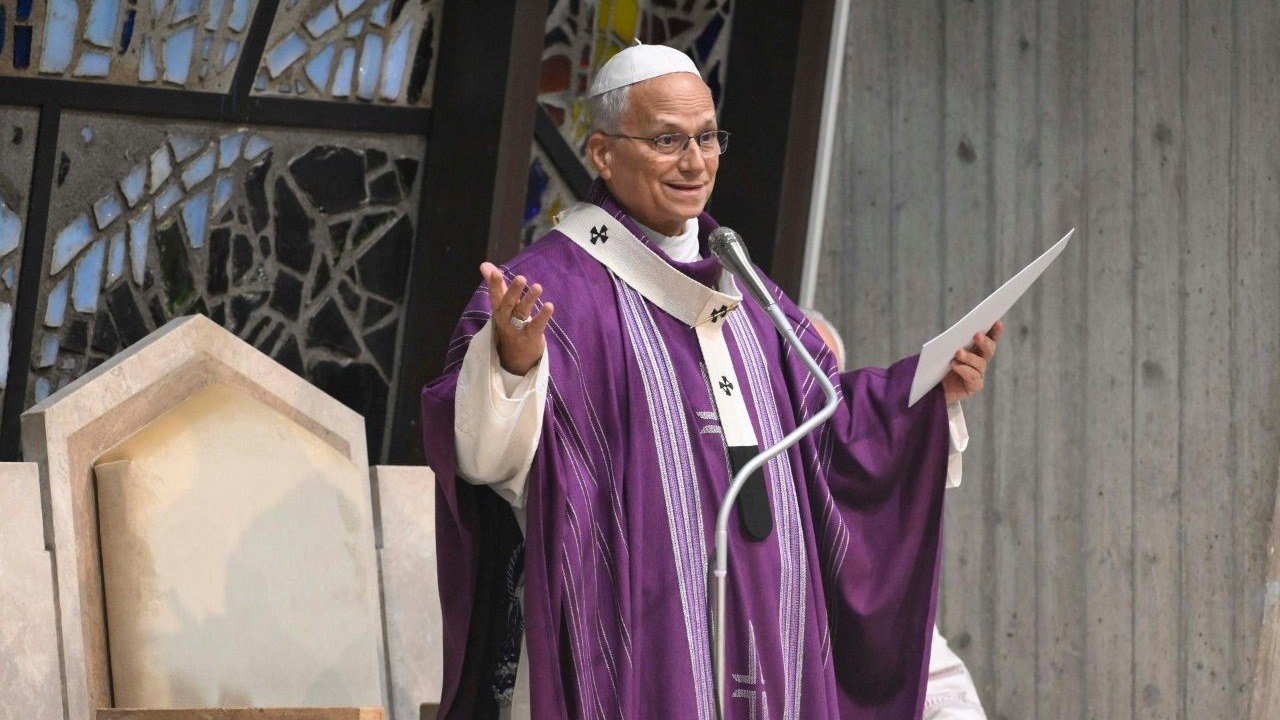
On the First Sunday of Advent Leo XIV travelled to Acilia, in the southern sector of the Diocese of Rome, for a pastoral visit to the parish of San Carlo da Sezze. Arriving at around 4 pm, he greeted the faithful outside and met children and young people (the arrival); at 5 pm he presided over Mass in the packed church (video of the opening, the elevation). In his homily, published by the Holy See in Italian, he pointed to two attitudes for Advent, prayer and vigilance, and entrusted the parish with its young people and the memory of its first parish priest, Fr Mario Torregrossa. All quotations below are our translation.
"As your Bishop". The Pope said he was "particularly glad to begin the Advent journey" with the community, which next year will mark the fortieth anniversary of the church's dedication. He sent a thought "to those who cannot be here: the sick, people who are alone, those going through particular trials". "As your Bishop, I come to share prayer with you and to confirm you on the journey of faith."
"O that you would tear open the heavens and come down!" Starting from Isaiah's plea (Is 63:19), "the cry of a people who bear the wounds of their history", Leo XIV asked the Lord to come "into our families, into our communities", "especially where human dignity is most humiliated and where hope risks being extinguished". Yet "our plea has already been answered": in Jesus "God entered our history once and for all". Prayer and vigilance, he explained, "are inseparable, because whoever prays learns to sense the closeness of the Lord, and whoever keeps watch trains himself to guard the desire to meet him".
Prayer does not erase suffering. "We are the clay, and you are our potter" (Is 64:7): to pray, the Pope said, "is therefore to entrust ourselves to the Lord". Prayer, "even if it does not always change the circumstances around us, gives us light and strength to face them", teaching us to bring before the Father "all the pain of the world: peoples wounded by war, families tried by precariousness, those who cannot find work, those without a home, those who feel that no one is waiting for them". He added: "Prayer does not erase suffering. But it prevents us from getting used to it, it helps us to hope and it makes us neighbours to those in need." He invited the parish to pray together this Advent, "especially in your families", making room for the Word of God and for silence: "In a community that prays, the Lord changes hearts."
"Keep watch!" "In our frantic world one can be very busy and yet have a heart that is asleep," Leo XIV warned, commenting on the Gospel (Mk 13:33-37). Just as the master in the parable entrusts his house to his servants, God "entrusts to us our life, people, the gifts we have received", so that we make them grow "caring for the most fragile, working together without seeking our own prestige", with a reference to the encyclical Magnifica humanitas. "To keep watch, then, is to remain faithful to the good without needing to be seen: being there for one another, keeping promises, reconciling after disagreements, visiting the sick, accompanying those who are discouraged, doing one's work honestly." "We do not know the hour of his return, but we know how to wait for him: by loving as he has loved us."
A "house" among houses. The parish, the Pope said, is "a 'house' among houses". The church walls, "the fruit of the generosity of many families, hold sacrifices, prayers, gestures of trust": a heritage to be put to good use "by making room for those who arrive, seeking those who have drifted away, sharing with those in need and going out into the neighbourhood, to meet even those who perhaps will never spontaneously enter our spaces". At the centre is the Eucharist, "as Saint Charles of Sezze, your Patron, taught".
To young people: "Do not be afraid". Recalling the Madonna di Loreto - House of Peace youth formation centre, Leo XIV told young people that the Church, "before offering you activities, wishes to know what you are living and to welcome your questions", and that they too can help it "to grasp the new forms of loneliness that it perhaps struggles to see, and to find suitable languages to communicate the faith". "Do not be afraid to answer the voice of the Lord": "Life is a unique gift that no one else can offer in your place." He asked the whole community to trust young people, offering them "responsible educational relationships, safe environments and a closeness that respects each person's freedom and pace". "A house is open when whoever arrives finds not only a door, but someone willing to welcome them."
Remembering Fr Mario Torregrossa. The Pope recalled "with gratitude" the priest who, before the Holy House of Loreto, conceived the inspiration for a work for young people. "On 24 November 1996, thirty years ago, while he was praying right here, he suffered a very serious assault": a wound to be remembered "so as not to forget his suffering, the closeness of those who supported him, and above all to make our own his example of perseverance in charity and forgiveness. The evil he received never extinguished his desire to live, to serve and to love."
A final "thank you". "Today I am here to say 'thank you' to the Lord, 'thank you' to all of you: to those who proclaim the Word, to those who accompany young people, to those who serve the poor, to those who look after the premises, to those who support the community with hidden prayer. God knows every good deed, even the one that no one sees." According to Vatican News, the Mass was concelebrated by the Cardinal Vicar, Baldo Reina, and the auxiliary bishop for the southern sector, Bishop Andrea Carlevale; at the end the parish priest, Fr Simone Giovannella, thanked the Pope ("It was a true celebration") and presented him with an icon of Saint Augustine painted by a parishioner.
Sources: Holy See, homily text (Italian); Vatican News. Quotations are our translation.
Source: Santa Sede