

APOSTOLIC JOURNEY · URUGUAY · ARGENTINA · PERU
LEO XIV · NOVEMBER 6-17, 2026
Leo XIV in Luján: “Argentina, arise and walk”
In his last great celebration in Argentina, in the square before the Basilica of Our Lady of Luján, the Pope proposed a path of reconciliation, enlightenment by the Word, communion and mission, and remembered Pope Francis.
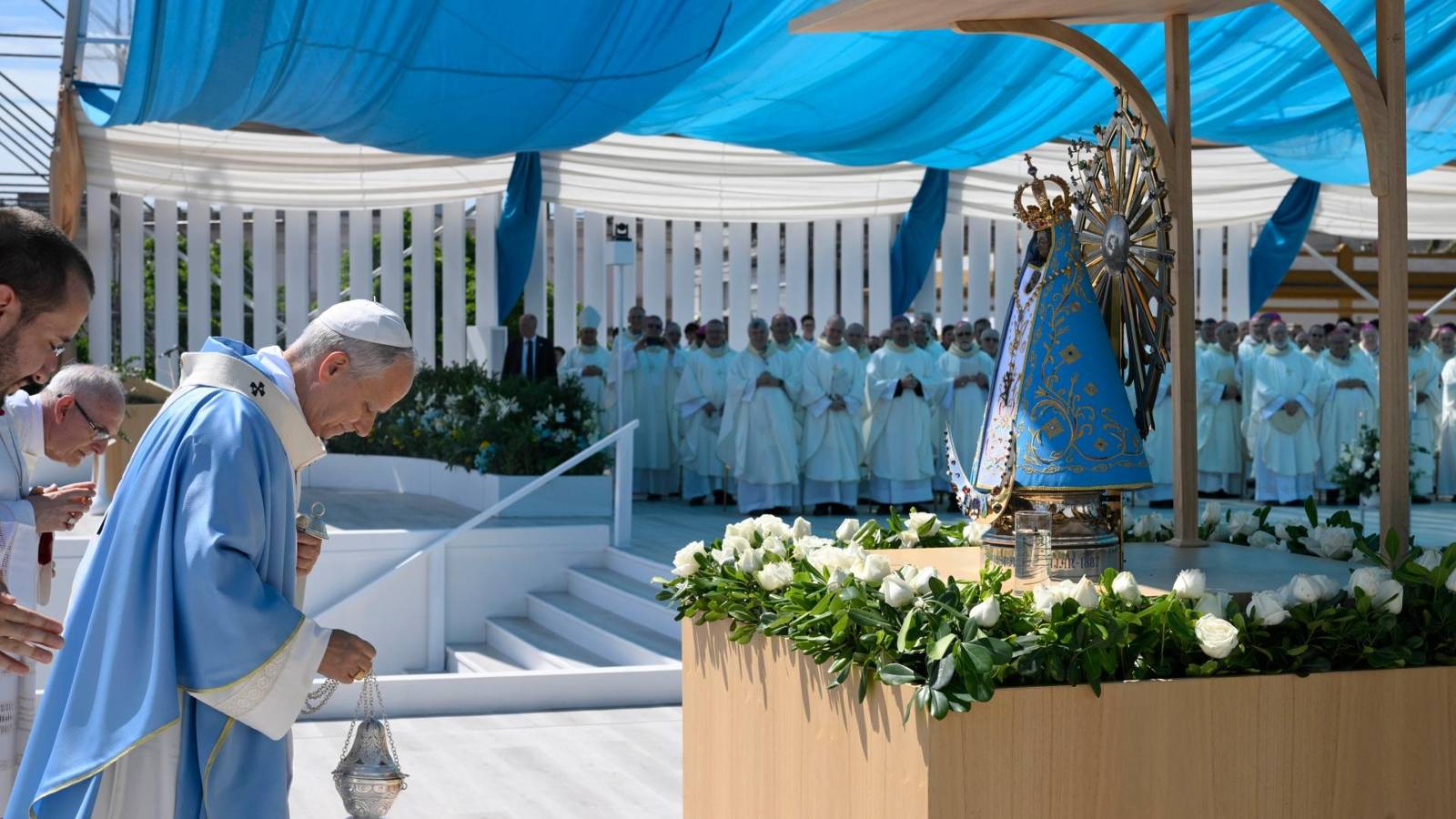
Today, 11 November, Leo XIV presided at Holy Mass in the square in front of the Basilica of Our Lady of Luján, the last great public celebration of the Argentine leg of his apostolic journey to Uruguay, Argentina and Peru. According to the Holy See’s official programme, the Mass was scheduled for 10:00 local time (14:00 in Rome), after the visit to the federal prison complex in Buenos Aires. Later in the day the Pope will take his leave of Argentina and fly to Lima, arriving at Callao at 17:30 local time (23:30 in Rome).
A huge crowd filled the avenues leading to the shrine. Vatican Media images show the popemobile moving slowly among the faithful, many of them waving Argentine flags; the Pope then stepped down and continued on foot along the barriers, shaking hands and greeting those who reached out to him. Onto the outdoor altar platform was carried the small statue of Our Lady of Luján, patroness of Argentina, just 38 centimetres tall, as Vatican News recalls: those present welcomed her with the cry “Viva la Virgen” (“Long live the Virgin”). The Pope celebrated in a light-blue and white chasuble, the colours of the Virgin’s mantle, also visible in Vatican Media photographs.
The EFE news agency, reported by Argentine media, said more than two million faithful from different parts of the country took part in the celebration. At the time of publication the Holy See has not issued an official estimate. According to the same agency, Estela de Carlotto, president of the Abuelas de Plaza de Mayo, and the Nobel Peace Prize laureate Adolfo Pérez Esquivel were among those present in the section reserved for special guests.
The memory of Pope Francis. Opening his homily from the reading from Isaiah, the Pope dwelt on Argentina’s geography — “vast grasslands and rushing rivers,” glaciers, deserts, the whole land of the “end of the world,” which “sings the glory of the Lord.” In these days, he said, he had been able to see “the richness of Argentina, not only in its geography but also in its people,” “in the creativity, the spontaneity and the life that overflows at every step.” He thanked God for the chance to meet “this people so dear to us, who open their doors to everyone, who share their bread and their music, where there is always a place at the table for the one who arrives, a free moment to talk ‘over mate after mate,’ a hand stretched out to those in need.”
His thoughts then turned to Pope Francis, who “always carried in his heart” the “Patroncita morena” — the “little brown Patroness.” “He taught us by his life, and he continues to point this out to us from the place he chose for his burial, so close to Holy Mary, always to love her and venerate her.” Francis is buried in the Basilica of St Mary Major in Rome. The Pope also recalled the words with which his predecessor often took his leave: “May Jesus bless you and may the Holy Virgin watch over you.”
(Homily quotations: our translation from the official Spanish text published on vatican.va; the official English version does not yet appear to be online. An official Italian translation is available.)
Four steps, as in every Eucharist. With a grateful heart, Leo XIV proposed “a path, which is the same one we live in the celebration of every Eucharist.” It consists of four steps: “reconciliation, enlightenment through the Word of God, communion and being sent on mission.” “Mary at the foot of the cross unites herself to the Eucharistic Sacrifice and accompanies us on this journey.”
The first step starts from a hard reality. “Many of our brothers and sisters, or even we ourselves, our families, may currently be living through moments of Calvary, suffering because of illness, poverty, lack of work, discrimination or family breakdown.” In those moments, he said, we understand the feelings of Mary at the foot of the cross. And just as she received from her Son a new mission, “we too are called to receive the grace of God and to live processes of forgiveness and reconciliation that renew peace, hope and charity within us.”
“Let us be sincere, let us recognize our failings and ask the Lord’s forgiveness,” he added, quoting the Zamba del perdón: “forgiveness for that beggar, for that tear I caused to shine; forgiveness for those eyes that, looking into mine, I did not want to look at.” Then came the appeal to the country: “We also need to be reconciled with our history and with our present, in order to bring forth a new future, in which love has the last word.”
The Word that enlightens, the table that welcomes. The second step recalls the disciples on the road to Emmaus, who were walking “with sad faces, discouraged, cast down by hard reality,” and whose hearts burned when the Risen Lord explained the Scriptures. “That is also, many times, our experience. We feel tired, disappointed, disoriented. We need a compass, a guide: we have it in Sacred Scripture!”
After reconciliation and enlightenment, “we are called to communion.” Christ himself invites us to his table, “and at it we are all welcome.” “There is a place for everyone, especially for those most in need: the poor and the hungry, migrants, the sick and prisoners, with whom the Lord identifies.” Quoting his own encyclical Magnifica humanitas, the Pope said that “the Eucharist, the sacrament of unity, nourishes our belonging to the body of Christ and teaches us to share. The diverse sensibilities present in the Church, the strong convictions that animate each person, are a richness if they remain anchored in the certainty of unity as a gift received and a task to be taken up.”
Communion, he warned, “does not shut us in on our personal affairs” and “impels us to take an active part in a community.” It is not a matter of doing great things, but of “remaining faithful beside the Lord,” as Mary did, and of “painting each of our days with the colour of hope.” He pointed to “heroic gestures of charity” already present among the faithful people: “the father who rises early every day to bring bread home,” “the mother who accompanies her sick child through the long nights in hospital,” “the good friend who shares his time with those in need.”
“Argentina, arise and walk.” The last step is the sending on mission, “just as we receive it at the end of Holy Mass.” “Go and proclaim!” the Pope said, “because ‘we cannot keep silent about what we have seen and heard.’” And again: “Go and evangelize, proclaim the joy of the Gospel with words and good works. Argentina, arise and walk.” He closed the passage with the words of St Augustine: “Love, and do what you will”; “let the root of love be in you, for from that root nothing can come forth but good.”
He then entrusted himself to the Mother of Luján, recalling that his pontificate began on 8 May, the day of her feast: “Like millions of Argentines who come to your home to implore your maternal protection, I too wish to take shelter under your mantle. Guide me, Mother, in the apostolic mission the Lord has entrusted to me. And guide and accompany the Argentine people on their journey. Help them to build bridges of charity and networks of solidarity.” He asked that the people continue to walk “paths of reconciliation, communion and mission,” “firmly grounded” in Jesus Christ, “the cornerstone.”
The consecration. After the homily, Vatican Media images document the heart of the celebration: before the Basilica, Leo XIV raised the Host and the chalice at the consecration, while the faithful prayed with joined hands. At the time of publication, official sources have not yet given the time at which the Mass concluded.
Follow the journey live blog: [Pope Leo XIV’s Latin America journey](/articolo/pope-leo-xiv-s-latin-america-journey-live-updates-c2a5?lang=en).
What we do not know. At the time of publication, the Holy See website has the original Spanish text of the homily and the official Italian translation, but not yet the official English version. The Press Office has not yet issued an official estimate of those present. Official sources have not yet indicated whether, or at what time, the celebration ended.
Sources: Homily, official Italian text on vatican.va; original Spanish text; programme of the Mass, vatican.va; Vatican News, Christopher Wells; Vatican News, on the shrine of Luján; EFE, via Infobae, on the presence of Estela de Carlotto and Adolfo Pérez Esquivel; Vatican Media video and photographs.
#LeoXIV #Vatican
Source: Santa Sede (omelia, vatican.va)
Everything on the journey: programme, Vatican Media live stream and live updates
Follow the journey →