

APOSTOLIC JOURNEY · URUGUAY · ARGENTINA · PERU
LEO XIV · NOVEMBER 6-17, 2026
Leo XIV in Santa Cruz de Succhabamba: the simple faith of the Andes, an antidote to superficiality and consumerism
At Mass with indigenous farming communities in his former Diocese of Chiclayo, the Pope praises popular piety and honest work, and says the cry for justice is “a matter of great concern for both the Church and society”
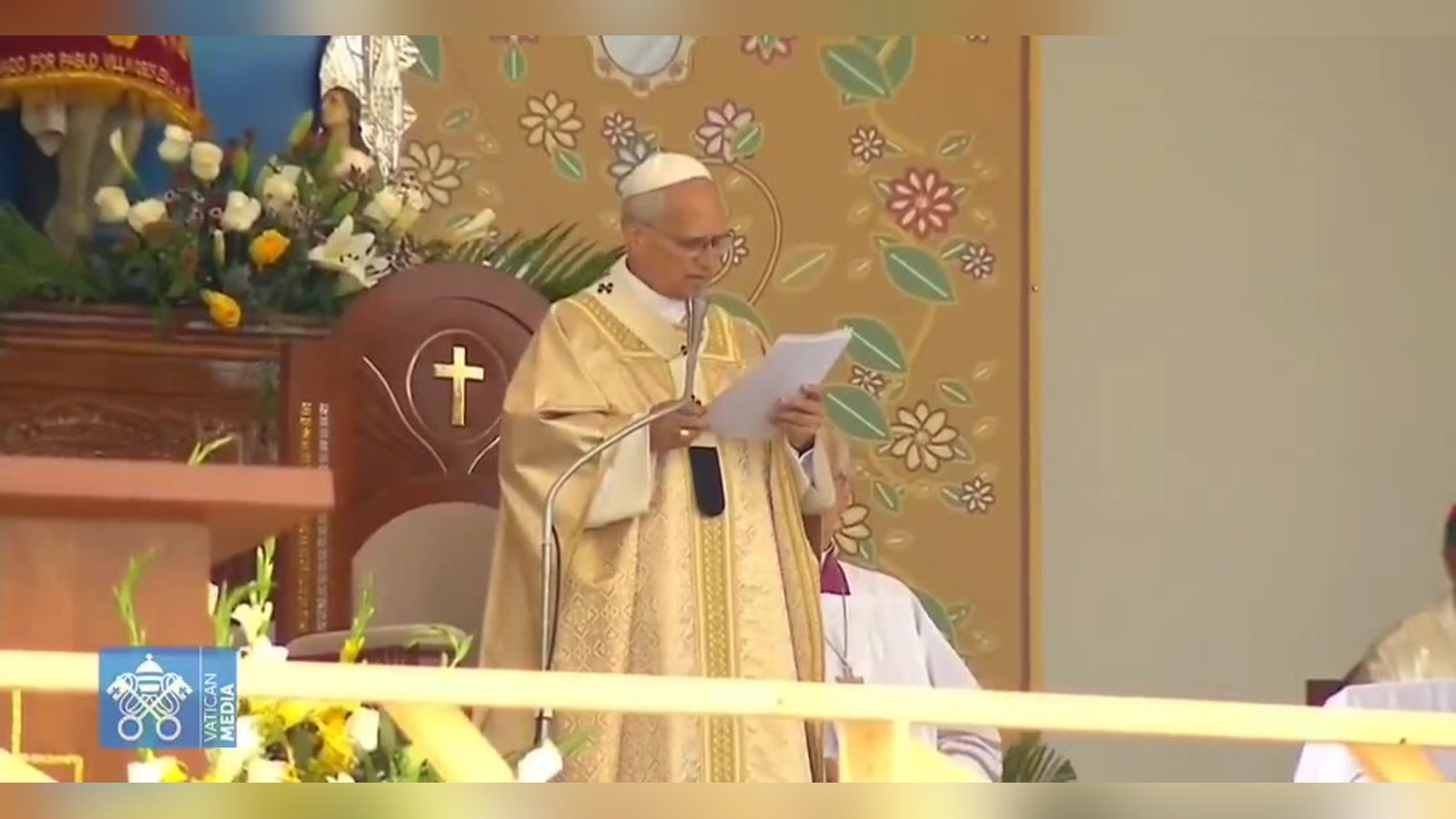
"The Lord knows the paths you travel, your hardships, your worries, and the challenges you face." Leo XIV offered this reassurance on Saturday, 14 November, in his homily at the votive Mass of God's Mercy on the esplanade of Santa Cruz de Succhabamba, a small town in the Peruvian Andes, some 2,000 metres above sea level, in his former Diocese of Chiclayo, celebrated with the indigenous farming communities of the region. The Mass began at 11 a.m. local time (5 p.m. in Rome), on the ninth day of the apostolic journey to Latin America. The Pope spoke in Spanish: quotations follow the English translation of the homily published in the Holy See Press Office Bulletin and by Vatican News, unless marked as our translation.
The return of "Padre Roberto". According to Vatican News, the Pope's helicopter took off at 9:20 a.m. local time from the Teniente Coronel Pedro Ruiz Gallo Air Base in Chiclayo, after the rite of coronation of the Immaculate Virgin; the flight lasted 47 minutes. The bells of the Immaculate Conception parish were rung by hand to welcome back "Padre Roberto", as locals called Robert Francis Prevost during his years of ministry in Peru. Before Mass the Pope prayed in the Blessed Sacrament chapel and before the Señor del Costado, the town's patron, laying flowers and lighting a candle, and greeted the faithful and some sick people and people with disabilities, telling them: "You too are part of the Church; we want to be close to you" (our translation). He then rode in the popemobile among the faithful on the esplanade.
A pilgrimage of faith. Pope Leo said he had come to share once again "the joy of being a disciple and missionary of Christ," and described the long journey of the faithful from rural Andean communities as "a pilgrimage of faith" to encounter Jesus, venerated in Santa Cruz as El Señor del Costado. Paying tribute to the missionaries who first brought the faith to the region, he said: "Since the arrival of the first missionaries… the seed of the Gospel has never ceased to take root and bear fruit in these lands, quietly, far from applause or great recognition." Through them, "faith has grown simply and genuinely, founded on the daily living of Gospel values and expressed in traditions and festivals that bring peoples and generations together." He thanked the catechists and lay people who care for communities where priests are often lacking.
Praise for popular piety. Quoting Saint Paul VI (Evangelii nuntiandi) and Pope Francis (Evangelii gaudium), the Pope described popular piety as a force for evangelization in which the faith once received has become embodied in a culture and continues to be passed on. It values essential things such as the land, honest work and the family, he said, and offers "a healthy antidote to the superficiality and consumerism so widespread today" (our translation).
The wounds of the Andes. Turning to the parable of the persistent widow, Pope Leo stressed the importance of praying "without losing heart," but said the parable "is an invitation to open our eyes to the many painful situations around us." The widow's plea for justice "is still sadly heard today, unanswered, on the lips of so many men and women," which is "a matter of great concern for both the Church and society." According to Vatican News, in the Andes these situations include people forced to leave their land for the coastal cities, communities emptied by falling birth rates and the lack of generational renewal, and the challenge of "the equitable sharing of the benefits linked to the resources of the land" (our translation). He warned against the temptation "to give in to discouragement, resentment, or evil," which "will never lead to progress and peace," and said that selfishness, injustice and evil must be overcome by prayer, patience and perseverance in denouncing what is wrong, working diligently for the necessary changes "while never losing trust in God."
Dignified work. "Where there is faith, there is prayer," the Pope said. He commended those who "strive to provide people with dignified jobs… helping to promote authentic models of integral human development through employment." He concluded: "May el Señor del Costado, venerated with such devotion here in Santa Cruz, bless you, protect you, and always inspire thoughts and gestures of unity, charity, and peace." After Mass the Pope flew back to Chiclayo by helicopter.
"He would find faith". Before the final blessing the Pope added a few off-the-cuff words, published in the Bulletin: "We have heard the words of the Gospel in which Jesus asks: 'When the Son of Man comes, will he find faith on earth?' (Lk 18:8). I know that if Jesus decided to come to Santa Cruz, he would find faith! Thank you for your witness. Thank you for your fidelity to the Church" (our translation). According to the Holy See Press Office, more than 20,000 faithful attended the Mass; the Pope left by helicopter at 12:50 p.m. local time and landed at the Chiclayo Air Base at 1:30 p.m., before going to the Bishop's House.
Updated at 9:55 p.m. (Rome time) with the official texts of the homily, the greeting in the parish and the closing words, published in the Holy See Press Office Bulletin.
Sources: Holy See Press Office Bulletin, Vatican News, Vatican News Italian.
#LeoXIV #Vatican
Source: Sala Stampa della Santa Sede
Everything on the journey: programme, Vatican Media live stream and live updates
Follow the journey →