

Leo XIV to UISG–USG superiors general: "If we want to create unity, let us serve with charity"
In the Synod Hall the Pope holds a spontaneous dialogue with more than 250 superiors general on unarmed peace, the evangelical counsels, synodality and artificial intelligence
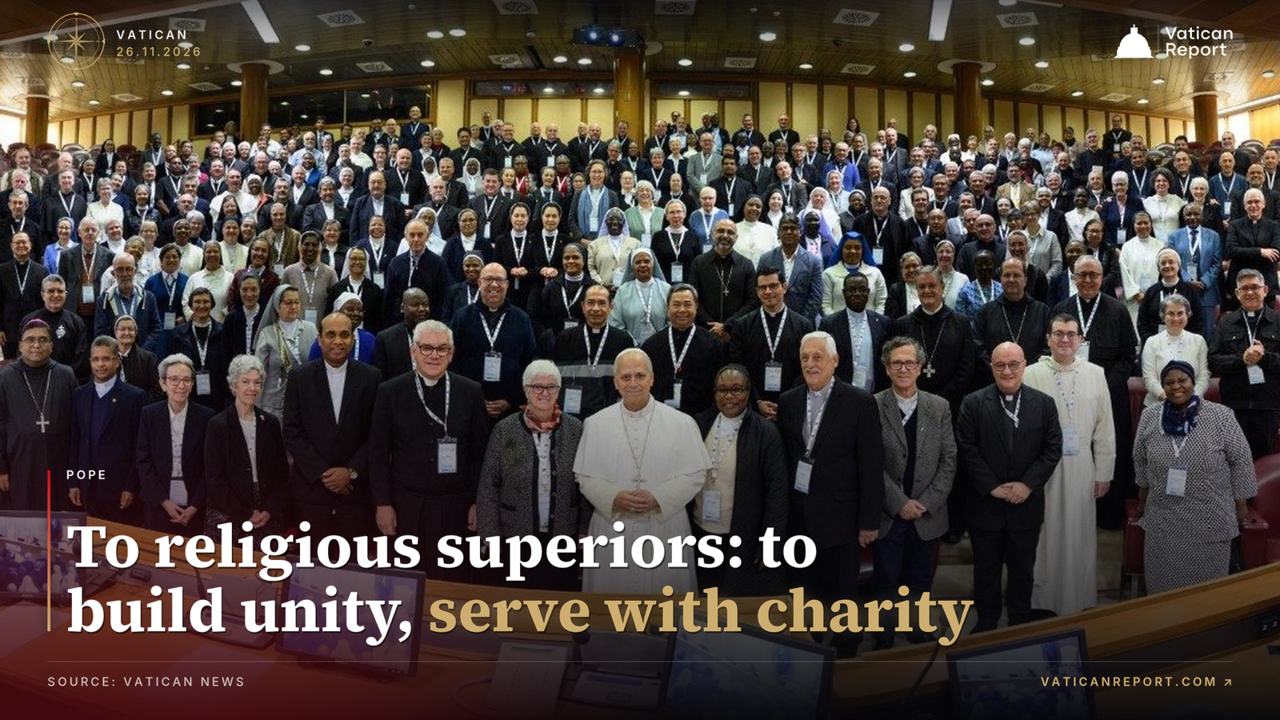
Pope Leo XIV on Thursday, 26 November, met more than 250 men and women superiors general in the Vatican's Synod Hall, at the conclusion of the second Joint Assembly of the International Union of Superiors General (UISG) and the Union of Superiors General (USG). Held from 25 to 27 November at the Fraterna Domus in Sacrofano, the assembly is reflecting on the question: "What would an 'unarmed and disarming' way of exercising leadership look like in our congregations?" The audience was confirmed by the Holy See Press Office (Bulletin B0957).
Thanking the participants and their communities, the Pope observed that "the Church needs consecrated life," highlighted its missionary dimension and its contribution to evangelization, and then opened a spontaneous dialogue with those present, Vatican News reports.
## Unarmed peace is rooted in the risen Christ
Asked how religious can become artisans of peace, Leo XIV said that an "unarmed and disarming peace" is rooted in the risen Christ. "The peace to which we all aspire, which does not need weapons and which is capable of disarming armies and hearts, is therefore the peace of Christ and is a gift of God," he said. This peaceful revolution of the Gospel, he explained, begins with each person's daily response to God's call through the profession of the evangelical counsels, shaping relationships within religious communities, the Church and society.
## Leadership as service
Addressing divisions and difficulties within religious congregations, the Pope recalled St Augustine's teaching that superiors should not consider themselves happy because they exercise power, but because they serve through charity. "If we want to create unity, let us serve with charity," he said, urging particular care for those who are fragile or difficult. Leadership, he added, requires open and patient listening and a willingness to suffer for the good of others: superiors must be both "an embrace that warms the heart and a word that encourages, reminds and corrects." He also stressed prayer, recalling that the responsibility entrusted to superiors belongs first and foremost to the Lord.
## The evangelical counsels as prophecy
In a polarized world, Leo XIV described consecrated life as one of the most significant forms of prophecy the Lord offers humanity, presenting chastity, poverty and obedience as instruments of healing in a society marked by possessiveness and self-interest. "Chastity frees the heart and sets it ablaze with charity towards God and neighbour," he said; poverty frees people from attachment to material possessions and makes them attentive to others' needs, while obedience teaches them to commit their freedom to the good of their brothers and sisters. Lived together, the counsels make religious communities "a beacon that illuminates and guides the common journey."
## Synodality and artificial intelligence
"Living synodality means, first of all, placing ourselves together in listening to the Spirit," the Pope said, adding that religious life teaches people to walk together, moving "from the 'I' to the 'we', from thinking alone to thinking together, from living alone to living together."
Responding to a question about artificial intelligence, he described it as a new instrument whose potential is still only partly understood. Religious can contribute to its responsible development through their spiritual depth, charity and humility, but consecrated life must continue to bear witness to "the unique and inalienable dignity of the person before the Creator and every other creature or artificial device," and to the irreplaceable role of human intelligence, conscience and freedom in guiding technological innovation. Religious, he concluded, can remind society of "the importance and beauty of the slow, demanding and wise path of walking together."
The official text has not yet been published; quotations are from Vatican News.
Source: Vatican News