

«Last night I saw the entrance to hell»: the Diary and Francis's mystical face
How the book came about, the role of Fernández and Leo XIV, and Bergoglio's most striking lines. With two coincidences of dates that the Diary does not explain.
On the night of 6-7 June 2018, Pope Francis wrote, in the black plastic-covered planner he kept at Casa Santa Marta: «Last night I saw the entrance to hell.» «I leaned out to look a little and it terrified me.» «It was before I went to sleep.» «I grasped the Rosary as a weapon.» «I thank the Lord for this help.»
Ten weeks earlier, on 29 March, Holy Thursday, in La Repubblica, Eugenio Scalfari had attributed to him a very different sentence: «There is no hell, there is the disappearance of sinful souls.» That same day the Holy See Press Office stated that the Pope had received the newspaper's founder «in a private meeting for Easter, without, however, giving him an interview», and that «no quotation in the aforementioned article should therefore be considered a faithful transcription of the words of the Holy Father» (official Italian text; our translation).
The Diary, released today by the Vatican Publishing House, does not mention Scalfari and does not connect the two facts. What remains are two dates, exactly seventy days apart, and a note that today is read with a different weight.
It is one of the lines that, together with the rest of the volume, force a rereading of Francis. In Corriere della Sera, Cardinal Víctor Manuel Fernández, who edited the book, puts it without circumlocution: «Pope Francis was a mystic.»
The planner he pointed to one afternoon, at Santa Marta.
Fernández tells the story of how the book came about in an interview with Vatican News conducted by Andrea Tornielli, and in a video released today by Vatican media. One afternoon, at Santa Marta, the two were speaking privately about the possibility of preparing a document on what to do if the Pope lost consciousness irreversibly. That text, the cardinal says, «did not go ahead». In that context Francis pointed him to a space with three documents and a planner. Opening it, Fernández understood that it was being used «as a kind of diary», without managing to read anything. Francis told him: «You others will see about this». The cardinal remembers the phrase «whatever may serve for edification»: he was asking him, when the time came, to choose what might help others.
After the election of Leo XIV, Fernández says that «after a few months» he worried about where that material would end up, «in whose hands it would finish, or whether it might simply disappear». The new Pope «showed an interest, and two days later he found the box containing all the texts», sent it to him immediately and «agreed with everything», including the comments explaining the context: publishing «only the texts», Leo XIV said, «could confuse readers who did not know Francis in depth». The work, Salvatore Cernuzio reports in Vatican News, was completed «after a year».
When he opened the box, Fernández says, he was «surprised» and «shocked»: not gossip, but «essential facts for understanding first-hand the person and the soul of Francis».
The volume, about 160 pages according to Vatican News (176 according to Il Foglio, priced at 16 euros), gathers notes from 20 December 1992 to 18 August 2024 and is released in five languages and 94 countries. It will be presented on Saturday 28 November in Milan, at BookCity, in the church of San Fedele at 5 p.m. The full account of today's publication is in our article this morning.
What was left out.
This is not the complete diary. Left out, Fernández explains to Vatican News, are «paragraphs about private matters concerning living people» that Francis «would not have wanted to make public», «a few phrases that add nothing or are repetitive» and «many parts written in strange signs, like hieroglyphics», which the cardinal believes should be respected. The book, he adds, is organised by theme and «contains everything worth including, even things that are very spicy and unsettling, without hiding anything».
The lines that remain.
Some are laconic. On 12 February 2013, the day after Benedict XVI announced his resignation, Bergoglio wrote: «Yesterday the Pope resigned.» On 21 July 2013: «On 13 March they elected me Pope.»
Others are bare confession. Francis leaves a terse «I am afraid», referring to the fear that he was unequal to his role or might «do harm» to others, even asking the Lord to take him «away». He was, Fernández says, «very sensitive to any failing toward people». He noted even the smallest gestures: «I did not greet that lady quite properly when she left»; «I forgot to visit someone who was ill». Death, ANSA reports, «did not frighten him»; «for Bergoglio it was a little more difficult to accept old age».
Then there are the visions. Francis notes «three certain episodes in which I have no doubt that he appeared physically» — the devil. As Archbishop of Buenos Aires: «I saw him from the car window. I cannot forget his menacing and at the same time seductive eyes». In the chapel of the Carmel: «He looked at me with eyes of fire». «Then he tried to come closer and I fled, clutching the Rosary». They were not, he specifies, «compromising situations or temptations, but a fascinating presence, which invited curiosity». The third episode, on his return from the 2018 journey to Chile: «I saw him and heard his voice, triumphant, master of everything: “Now I have obtained everything I wanted”». And he adds: «But there is something that has remained, like an imprint».
In 2016 the notes become more alarmed. On 9 April: «The devil's attacks, in various forms, have increased, they are stronger and more sudden». And again: «If the devil is attacking so brazenly, it is because I do not have much time left and he wants his prey».
The vision of 7 June 2018 should be read together with these lines. The original text, Fernández tells Corriere, is in Spanish: «Vi las puertas del inferno, la seducción pagana con todas sus fuerzas». This is «in no way a hedonistic seduction»: Bergoglio, he says, was «extremely temperate», of «absolute austerity». «The pagan temptation is to reject the true God in order to worship idols, or worse still to worship oneself. The strongest temptation is power badly handled». In the same passage Francis also writes: «One slips into hell as if it were the most natural thing». «It is dangerous to draw near the door of hell because the flames can come out and burn». He closes: «Pagan seduction is strong… but there is no room for hope in it».
We have reported in detail the three appearances and the «imprint».
The 2021-2022 crisis, and a coincidence of dates.
One of the most intense passages, Cernuzio writes, is the spiritual crisis lasting «about two years of the pontificate, from early 2021 into 2022», as his illness worsened and with «decisive assaults by the forces of evil». Francis spoke of «dryness, desolation, a dark time». Fernández calls it «perhaps his worst period of temptations» and tells Corriere that the Pope never spoke to him about it, even though he received him «almost every week».
According to the cardinal, the crisis ended at Christmas 2022. On 30 December Francis noted, underlining the words: «Together with everything else, compassion for the poorest, the sickest, the humiliated…». On the same day he also wrote: «Jorge arrogant, self-sufficient, cynical and a liar about himself…». Another sign of that trial, again according to the interview, is that he had «lost the ability to weep»: for him tears were «a gift of God». In the chapel, however, he also left this: «He smiled… I felt the merciful gaze of Jesus».
From that crisis, Fernández explains, came two «documents that sum up Francis in his final years»: the exhortation C'est la confiance on Saint Thérèse of Lisieux (2023) and the encyclical Dilexit nos (2024). Earlier documents, he adds, «must be interpreted in the light of these two».
30 December 2022 is also the eve of the death of Benedict XVI, on 31 December. In that passage the Diary does not name Benedict and does not connect the two facts. It remains a coincidence of dates. Two days earlier, on 28 December, at the end of the general audience, Francis had asked for «a special prayer for Pope Emeritus Benedict, who is supporting the Church in silence». He then went to see him at the Mater Ecclesiae monastery. At the Angelus of 29 June 2021, on the seventieth anniversary of Benedict's priestly ordination, he had called him «dear father and brother». In private, Fernández tells Corriere, he used to say that it was «like having a wise grandfather at home».
The account of the crisis is in our flash this morning. On the coincidence of dates with the death of Benedict XVI we have written here.
«Pope Francis was a mystic».
«And his attention to the poor, to society, to politics did not diminish his mysticism», Fernández adds in Corriere. Francis, he says, «saw a divine message in everything: in dreams, in a word he had heard». At times, while speaking or celebrating, «he suddenly became serious, his face darkened, because he had seen something». Many, he told Corriere, «did not understand this, or with malice tried to deny it. They portrayed him as a cynic without faith, who believed in nothing, who had only a political project».
Of these intimate experiences, he stresses, Francis «never spoke». In the Diary he writes things such as «smiled at me», «spoke to me through a look», «I fell asleep in that loving presence».
There is a detail that illuminates more than many pages. From childhood Francis placed little prayer notes under the statue of Saint Joseph, and he did not stop as Pope: he called it «passive contemplation». When the notes decreased, he understood «that he was yielding to the temptation of power»; when they increased, he was comforted. «During the crisis, the notes had decreased. In the end there were so many that there was a fear the statue might fall». The same was true when he remained for a long time before the Salus populi Romani, «to let himself be embraced». In Corriere, Fernández also recalls a phrase of Saint Thérèse of Lisieux that Francis loved to quote: «I shall appear before God with empty hands, and He will fill them with his immense mercy».
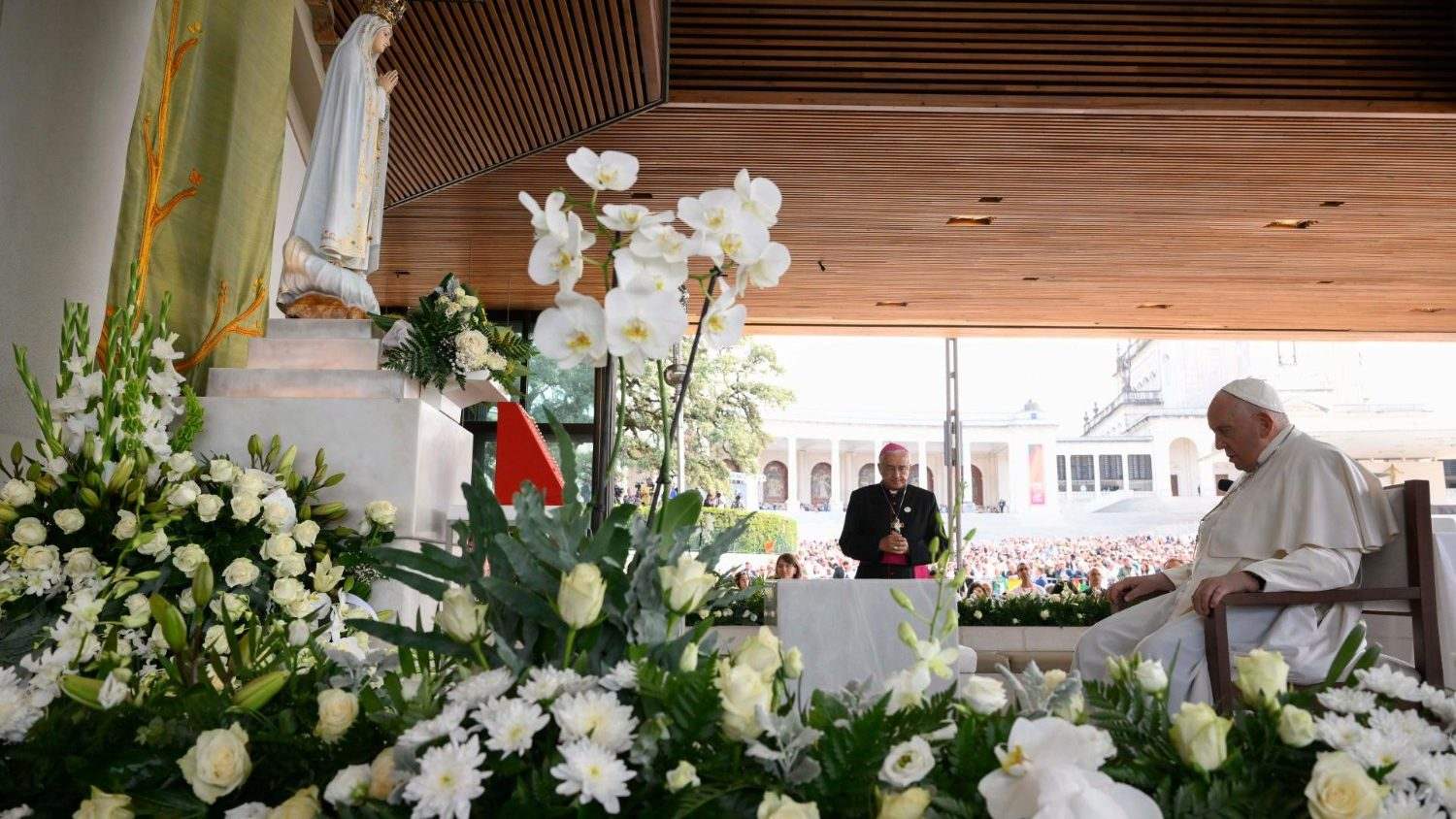
At Fatima, in 2023, during the journey to Lisbon for World Youth Day, he stood silent before Our Lady. The explanation is in a note from October: «I looked and I asked».
On Vatican News, Cernuzio writes that the book reveals Francis's «mystical side». The 2021-2022 crisis, he adds (this is the vaticanist's framing, not a formula of the Pope's), is similar to the «dark night» of Saint John of the Cross: «a stripping of the soul, without separation from God, for a more radical union with Him». Archbishop Bruno Forte, in Avvenire, finds in the Diary «the testimony of a man in constant search, abandoned into the hands of God and at the same time full of questions and expectations».
On 1 May 2019, in a passage Fernández names among those that struck him most, Francis had written: «I felt certain that the Lord loved me with a special love. It was a long moment in which the Lord showed me the love he has for me… It seemed as though he were like the mattress that enveloped me and kept me from falling apart».
The first reactions and the theme of mysticism are in our flash.
Judgments on collaborators, and one name.
ANSA reports that the volume also gathers judgments Francis offered on some of his collaborators. Of Robert Francis Prevost, now Leo XIV, he said that he had always been «a great pastor, a generous missionary and an irreproachable man». This is not, it should be noted, a handwritten line of the Diary: it is among the judgments collected in the book edited by Fernández. Of Cardinal Pietro Parolin he said that he was «an excellent diplomat, the cardinal who best understands international politics»; of Cardinal Gerhard Ludwig Müller: «he seems aggressive, but he is a good man, a really good, good man».
We have written about it here.
The last line.
The last entry is dated 18 August 2024, less than a year before his death, on 21 April 2025. Francis returns to those presences: «he is a presence lying in wait to intervene». And he asks the Virgin «to take care of me and to help me». After that date, Fernández writes, «he no longer felt the need to add anything else».
This is not a text written to be published. It is a planner from Buenos Aires, brought to Santa Marta, pointed out one afternoon with a single sentence: «You others will see about this». Fernández delivers the book with a feeling «before Francis, as if to say: “Here it is. I did it”». It is, he explains, «a way of vindicating him against very unjust criticisms» and of «letting him speak about himself».
What remains, in the end, is not a curiosity about a Pope's private life. It is a man who, on the night he saw the entrance to hell, grasped the rosary; and who, less than a year before dying, asked Our Lady to take care of him.
Sources: Vatican News (Salvatore Cernuzio and interview by Andrea Tornielli with Cardinal Fernández, 24/11/2026), Vatican Publishing House, ANSA, Corriere della Sera (Aldo Cazzullo), Il Foglio, Holy See Press Office (29/3/2018), vatican.va (audience of 28/12/2022; Angelus of 29/6/2021), Avvenire (Bruno Forte).
Photo: Vatican Media
Source: Vatican News