

APOSTOLIC JOURNEY · URUGUAY · ARGENTINA · PERU
LEO XIV · NOVEMBER 6-17, 2026
Leo XIV to Peru’s bishops: “Do not stop walking with this people”
In Lima the Pope takes the Inca Trail as an image of the bishop's mission, asks for a response to abuse “with truth, with justice” and, at the Midday Prayer in the Cathedral, calls for a Church “capable of building bridges where others raise walls”
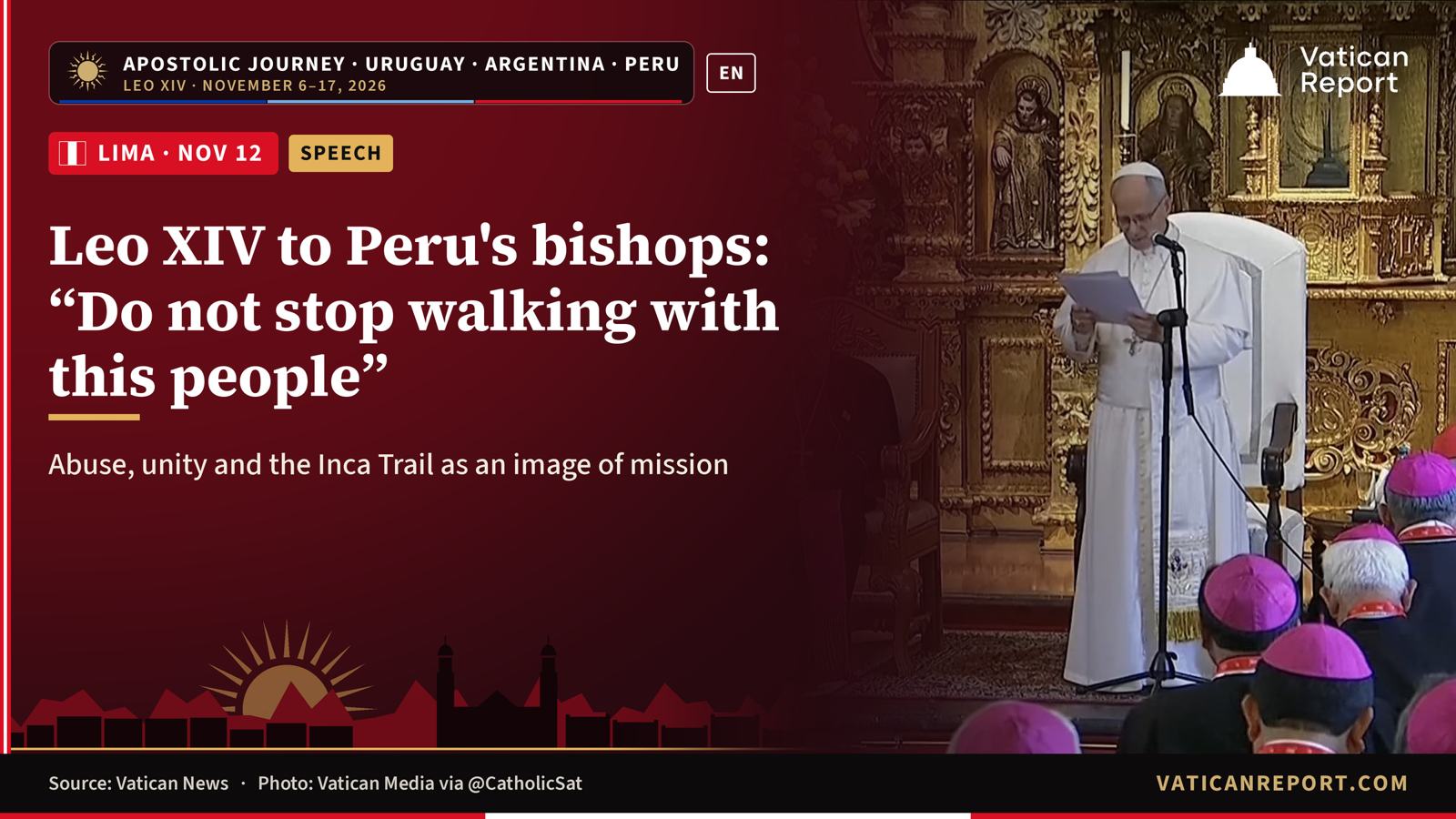
Leo XIV asked the bishops of Peru not to stop walking with their people. On the morning of Thursday 12 November, the second day of the Peruvian leg of his apostolic journey to Uruguay, Argentina and Peru, the Pope left the Apostolic Nunciature at 9 a.m. (3 p.m. in Rome) after celebrating Mass in private, stopping along the way at the Santuario de Las Nazarenas and at the Palacio Municipal, where he was presented with the keys to the city. At the Archbishop's residence he was welcomed by the President of the Episcopal Conference, Carlos Enrique García Camader, Bishop of Lurín, who accompanied him to the chapel. There, after the words of welcome, the Pope delivered a long address built around the image of the great Inca Trail, followed by the exchange of gifts and the group photograph, before walking to the Cathedral for the Midday Prayer. The address and the homily were delivered in Spanish. No official English text has been published in the Press Office Bulletin: the quotations below are our translation of the official text.
"He won't come, he won't make it." The Pope began by thanking the bishops, among other things, for their prayers "for the recovery of my health", adding with a smile: "You know there were some 'doubting Thomases' who said: 'He won't come, he won't make it.' But God is great, and his grace is greater than all of us. And I am truly very happy to be here with you."
The Church as a path. "The roads that cross the territory of a country also run through the soul of its people," Leo XIV said, recalling the Great Inca Trail, "that vast network that united territories, communities and cultures". The Church too is "a path of communion and of hope; a path that crosses the mountains of indifference, the deserts of individualism and the distances that separate people". Opening one's heart, as the motto of the visit asks, "means for a bishop knowing the way to God in order to walk it with the faithful People, and allowing God and the People to challenge his priorities". Like the chasquis who ran across the empire "carrying urgent messages and vital provisions", the bishop "is the messenger who brings the Good News of the Gospel, guards the treasure of the Word of God and administers the Sacraments". Opening one's heart also means knowing one's diocese "by entering homes, accompanying the sick, meeting young people and drawing close to communities that, because of their geographical distance or their social fragility, can rarely make themselves heard or be listened to".
Saint Turibius and the hardship of the road. The Pope pointed to Saint Turibius of Mogrovejo, who wanted the Gospel proclaimed in the languages of the indigenous peoples too: the Catechism "written in Aymara, Quechua and Spanish, bears witness to his missionary zeal". Like the Inca Trail, "the episcopal mission does not always proceed along open roads either", and from Saint Turibius we learn that "pastoral charity does not consist in avoiding problems, but in remaining faithful to Christ and seeking the greatest possible good for people". Leo XIV expressed his joy at the synodal process of the Peruvian Church and asked that it continue, so that "authority is not exercised despotically, nor does obedience become mere servility".
The saints and abuse. Alongside Turibius, the Pope recalled Saint Rose of Lima, Saint Francis Solano, Saint Martin de Porres and Saint John Macías: from them we learn that "charity begins with a simple gesture, attentive listening" and that "no person can be judged by their prestige, their origin or their social position". Then he turned to abuse: "Allow me to refer to a reality that has caused us so much pain: the abuse committed by members of the clergy or in church settings. We must respond as Jesus would, with truth, with justice, with forgiveness, with reparation and with an ever more decisive commitment to a culture of prevention and protection of the most vulnerable against these crimes."
Communion and bridges. Leo XIV recalled that in 2018, in this same place, he was "sitting back there" among the bishops when Pope Francis urged them: "Do not remain prisoners of divisions that fragment and diminish the vocation to which we have been called: to be a sacrament of communion. […] This was, is and will be the best evangelisation." Communion, he added, "is the foundation of the credibility of the Gospel", and the bishops' mission requires them "to be bridge-builders, to foster dialogue, to educate for encounter and to help heal the wounds that tear apart Peruvian society". "No bishop should feel alone on the journey."
Peru today. "We must ask ourselves which roads truly lead to Christ, and denounce the false ones," the Pope said. Peru "needs pastors capable of listening to the questions of their time and illuminating it with the light of the Gospel", to accompany families, support young people, "defend the life and dignity of every person" and help those who suffer "poverty, exclusion, corruption, violence and lack of opportunity". It is a mission that "requires uniting doctrinal fidelity with pastoral closeness". And before the Blessed Sacrament, he said, "the Church does not belong to us; it is Christ's. We are messengers who will one day reach the end of our journey. Only God remains!"
Three invitations. The address ended with three charges: "First: do not stop walking with this people. Second: let us not stop walking together, in episcopal communion, as witnesses of the unity we proclaim. Third: let us not stop opening our hearts: to God, so that he may renew our vocation; to our brothers, so that divisions may be healed; and to your people, so that they may find in you a 'father bishop' who is close, courageous and merciful."
Midday Prayer in the Cathedral. At 10.25 a.m. (4.25 p.m. in Rome) the Pope walked to the Basilica Cathedral of Saint John the Apostle and Evangelist, where he was welcomed by the Archbishop of Lima, Carlos Gustavo Castillo Mattasoglio, and by Víctor Solís Alfageme, Vicar General of the archdiocese and Dean of the Metropolitan Chapter. With bishops, priests, men and women religious, seminarians, synodal teams and pastoral councils, he presided over the Midday Prayer and gave the homily. "It is a great joy for me to be once again on Peruvian soil, close to a Church that is so dear to me. I come as a Father and Brother in the faith, as a Shepherd who loves his flock," he began. "I first came to Peru many years ago," he recalled, and he returns today "to encourage all of you to continue the work of spreading the Gospel, attentive to people's lives and needs".
Starting from the short reading from the First Letter of John, the Pope proposed several attitudes for being Church. First, faith in Christ, "the only foundation on which to build our Temple of living stones", following the example of Saint Turibius and looking to the Señor de los Milagros. Then reconciliation: "Peru has great need of this, of a Church that sows love, capable of building bridges where others raise walls, capable of listening, healing, forgiving and, at the same time, ready to acknowledge its own infidelities and to apologise humbly, taking responsibility for the wounds it has caused within itself and around it." Then peace, the "unarmed and disarming peace" he often speaks of: "Peace always begins 'here and now', and depends on how we behave, how we look at one another, respect one another and listen to one another." And unity, which does not erase differences but is a "space in which different voices, with the help of the Spirit and under the guidance of the Pastors, learn to blend without cancelling each other out, creating harmony".
The last point was mission, with a word for each group: bishops called to listen and to be close to their priests, priests to an "intense love for Christ", consecrated men and women to renew "the prophecy of their 'yes'", seminarians to cherish "the beauty and freshness of their calling". To the lay members of the pastoral councils and synodal groups he said: "the Church needs you, your contribution, your faith." At the end the Pope walked back down the central nave and went on foot to the Plaza de Armas for the meeting on the challenges and hopes for the future of the Peruvian people.
Sources: Holy See Press Office, Bulletin of 12 November 2026: B0905, address to the bishops of Peru and B0906, homily at the Midday Prayer (texts in Spanish and Italian); account of the meeting with the bishops (English).
#LeoXIV #Vatican
Source: Sala Stampa della Santa Sede
Everything on the journey: programme, Vatican Media live stream and live updates
Follow the journey →