

Pope speaks with Putin, appeals for a truce in Oleshky
After a first call in June 2025, Leo XIV again asks Moscow for a humanitarian gesture. The milestones of Holy See–Russia relations
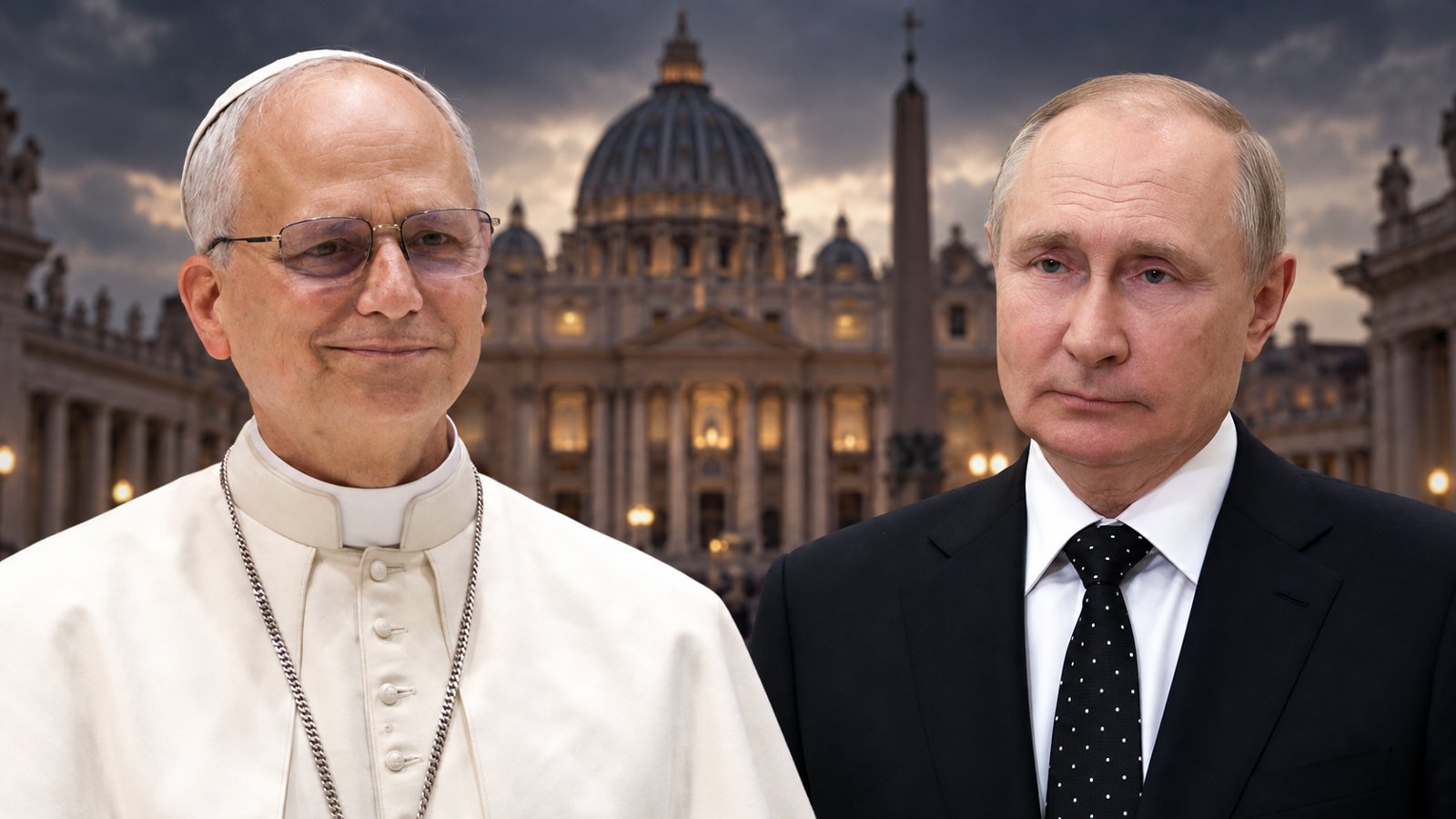
Pope Leo XIV spoke by phone today with Vladimir Putin, the Holy See Press Office announced. During the call the Pope expressed “deep concern about the grave humanitarian situation in the city of Oleshky, in the Kherson region,” called for “a ceasefire to allow the delivery of food and medical assistance, and the voluntary and safe evacuation of the civilian population,” and reaffirmed “the Holy See's commitment to promoting dialogue and peace.”
The news was released by the Press Office in a late-afternoon bulletin (Vatican News).
Moscow's confirmation. The Kremlin confirmed the call in its own readout (Kremlin). According to the Russian account, Putin wished the Pope good health and a speedy recovery after his surgery, a detail also reported by state agency Sputnik and not included in the Vatican statement. The call took place while the Pope is still at the Gemelli hospital.
The reactions. Ukraine's Embassy to the Holy See thanked the Pope “for this gesture of solidarity, support and commitment to the people of Oleshky,” noting that Kyiv had “repeatedly appealed to the Holy See at all levels.” The Kremlin's full readout gives Moscow's version: Putin thanked the Pope for his willingness to help resolve the conflict and for his humanitarian efforts; in response to the Pope's concern for civilians in Oleshky, which Moscow calls a “Russian” town, he blamed the Kyiv government for the humanitarian situation. The Kremlin says it supported the Vatican's intention to help create conditions for the population's safety and for vital supplies, and that the two sides “agreed to cooperate” on this. Putin also stressed Russia–Vatican cooperation in promoting common moral values and protecting Christians and Christian shrines; according to the readout, both sides want to maintain dialogue between the Russian Orthodox Church and the Catholic Church (Kremlin).
The Pope's initiative. According to SIR, Parolin told journalists: “It was the Holy Father who took the initiative to plead the cause of this besieged city.” In Oleshky, the cardinal said, there are about 2,000 civilians who “need humanitarian exit corridors.” On Moscow's response: “I hope that, faced with a request from the Holy Father, President Putin will agree to put into practice what the Pope asked of him. I think so” (our translation; SIR).
Trump: “I spoke with his brother”. Asked by Italy's Tgcom24 whether he will speak with the Pope after the Putin call, Donald Trump said: “I spoke with his brother. He's a fantastic person, he's a friend of mine. I told him: please, give him my best wishes” (our translation from Tgcom24's Italian).
The June 2025 precedent. This is not the first conversation between the two. On 4 June 2025, less than a month after his election, Pope Leo XIV and Putin spoke by phone. According to Matteo Bruni, Director of the Press Office, the Pope appealed for Russia “to make a gesture that would favour peace,” stressing the importance of dialogue; they also discussed the humanitarian situation, prisoner exchanges and the work of Matteo Zuppi in this area (Vatican News). The Kremlin described the conversation as “constructive” (Kremlin).
Diplomatic relations. The Holy See and the Russian Federation have had full diplomatic relations since 9 December 2009, at the level of Apostolic Nunciature and Embassy (communiqué). The decision had been agreed on 3 December 2009, during Pope Benedict XVI's audience with President Dmitri Medvedev (Press Office). Since 1990 the two sides had maintained official relations at a lower level.
Putin and the Popes. Putin was received twice by Pope John Paul II, in 2000 and 2003; once by Pope Benedict XVI, in 2007; and three times by Pope Francis, in 2013, 2015 and on 4 July 2019. Peace in the Middle East and Syria and, from 2015, the crisis in Ukraine featured in his talks with Pope Francis (Vatican News).
Zuppi's mission and the children. After Russia's invasion of Ukraine on 24 February 2022, Pope Francis entrusted Matteo Zuppi with a peace mission. From 28 to 30 June 2023 Zuppi was in Moscow to identify “humanitarian initiatives” that might open paths to peace: he met Yuri Ushakov, presidential aide, Maria Lvova-Belova, commissioner for children's rights, and Patriarch Kirill (communiqué). The fate of Ukrainian children taken to Russia was at the centre of the talks (Vatican News); Zuppi named their return to Ukraine a priority, “starting with the most fragile” (Vatican News).
Analysis. The facts point to a consistent line: the Holy See favours the humanitarian channel (aid, prisoners, children, civilians) as a way to keep dialogue open. Today's request for a targeted truce in Oleshky fits that pattern. Whether and how Moscow will respond remains to be seen.
#LeoXIV #Vatican #Putin #Russia #Ukraine
Source: Sala Stampa della Santa Sede