

Leo XIV at Sant'Andrea delle Fratte: "Rome's centre, a banquet table among the invisible"
On the feast of the Miraculous Medal the Pope invoked Mary "at a difficult moment in the history of humanity" and asked the parish for a faith that becomes charity.
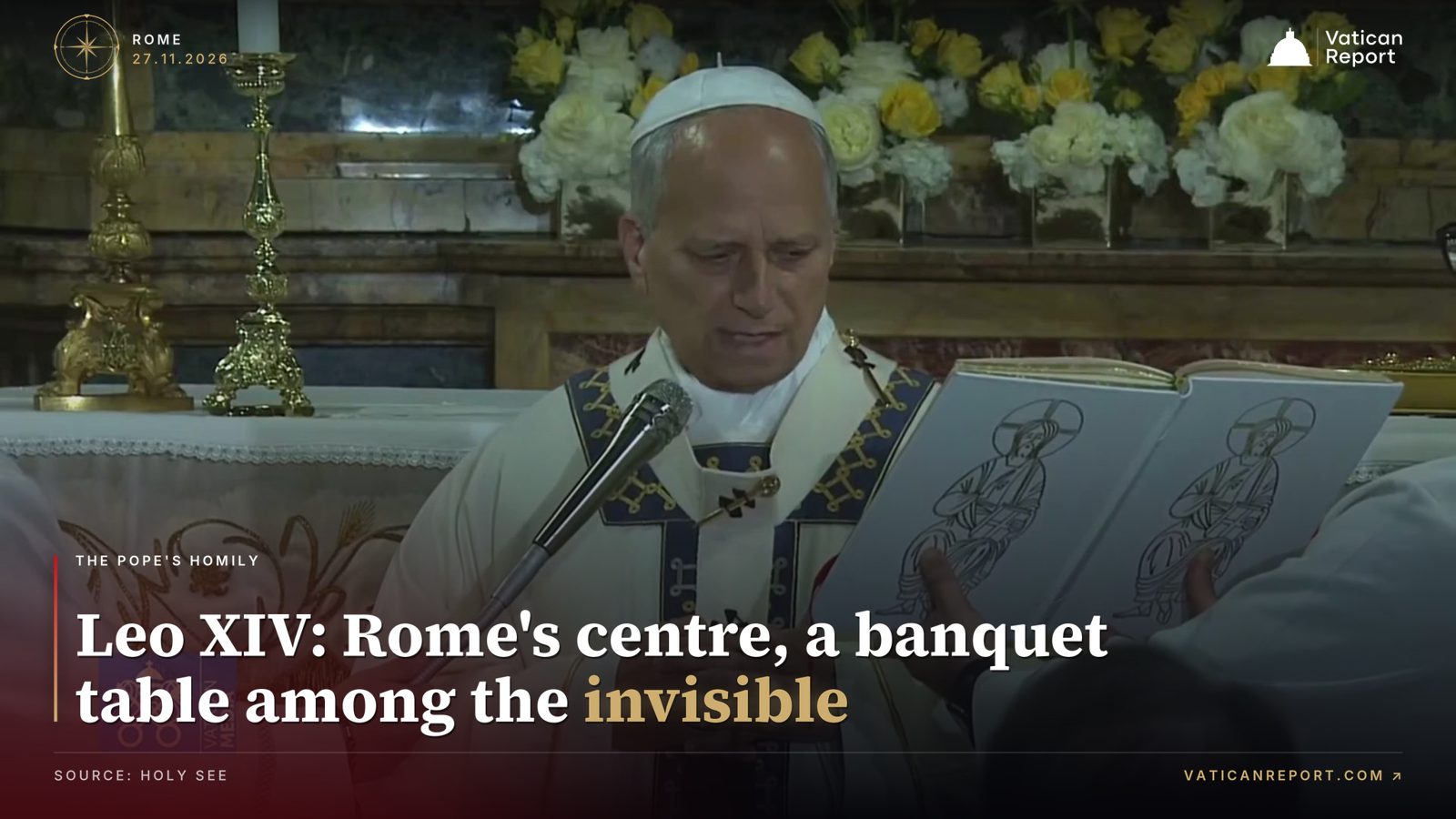
In the heart of Rome, at the Basilica of Sant'Andrea delle Fratte, Leo XIV celebrated Mass on the evening of 27 November for the feast of Our Lady of the Miraculous Medal, after praying before the altar of the Madonna of the Miracle (the supplication). In his homily, published by the Holy See, he described the city's historic centre as a banquet table surrounded by many invisible people.
"I come as a pilgrim". The Pope recalled that on 27 November the community remembers the Virgin's request to St Catherine Labouré to strike the "Miraculous Medal", and that at the foot of the Marian image in this church Alphonse Ratisbonne "was touched by Grace". "Like my Predecessors, I too wished to come to this place so dear to our Diocese", which Benedict XV called "the Roman Lourdes". He came, he said, "to invoke the help and intercession of the Virgin Mary at a difficult moment in the history of humanity, marked by wars and unjust inequalities that mortify human dignity" (our translation).
The wedding at Cana. Commenting on the Gospel (Jn 2:1-11), Leo XIV warned of the risk "of being seated at the banquet of life without living the feast prepared by the Lord". Mary's words, "Do whatever he tells you", are "more relevant than ever" in a time of crisis, he said. The Lord, he said, asks us to offer him "the little we have": "a humanity tried by the loss of peace, young people struggling to build their future, families in which dialogue has been lost, the loneliness of so many in the cities". He added: "Conversion, even before being a change of life, is a change of mentality."
Rome's table. "The historic centre of our City is like a banquet table laid out before the eyes of the world: monuments, palaces, shops, restaurants, pilgrims and tourists from every continent. Around this table, however, live and work people who often remain invisible." The Pope mentioned the poor sleeping on the streets, the lonely elderly, "many foreign brothers and sisters and workers with wages that wound their dignity", shopkeepers facing "exhausting hours" and growing economic uncertainty, and tourists and pilgrims seeking "meaning and welcome". "It is precisely from here that the Lord wants to restart the feast of humanity."
A call to the parish. He asked the community to serve those most in need, so that the beauty of the place "may translate into a faith that becomes charity", and invoked Mary so that in the shrine "the poor may find a hearing, foreigners welcome, workers respect, pilgrims a light of hope".
Meeting the parish. Before Mass the Pope met the parish groups in two rooms of the cloister, and then the pastoral council with volunteers and missionaries. According to Vatican News, he spoke of communities living "a somewhat hidden life, sometimes, but also very visible", "part of the mission of the Church" right in the centre of Rome, in a tourist area where visitors find "the living Church, made not of bricks and stones but of living people". He urged them to keep "walking together", pointing to Mary as a model: at the Visitation, despite her "own worries", she "does not think of herself, she goes out, she goes beyond", and a simple gesture can "change someone else's life, or a city, or a neighbourhood" (our translation).
The conclusion. At the end of Mass the Pope sang the Salve Regina in Latin, while Vatican Media's cameras rested on the image of the Virgin of the Miraculous Medal venerated in the basilica. Then came the exchange of gifts: the parish priest presented the Pope with a Miraculous Medal and an icon of Our Lady of the Miracle, and Leo XIV gave him a chalice (the video).
Sources: Holy See, homily text (Italian); Vatican News, meeting with parish groups (Italian). Quotations are our translation.
Source: Santa Sede