

APOSTOLIC JOURNEY · URUGUAY · ARGENTINA · PERU
LEO XIV · NOVEMBER 6-17, 2026
Leo XIV to Peru's clergy in Chiclayo: “Our primary identity is that of sons and daughters of God”
At the Shrine of Our Lady of Peace, with bishops, priests, religious, seminarians and synodal teams among some 5,000 people, the Pope calls for a more synodal and missionary Church: “Communion must precede mission”
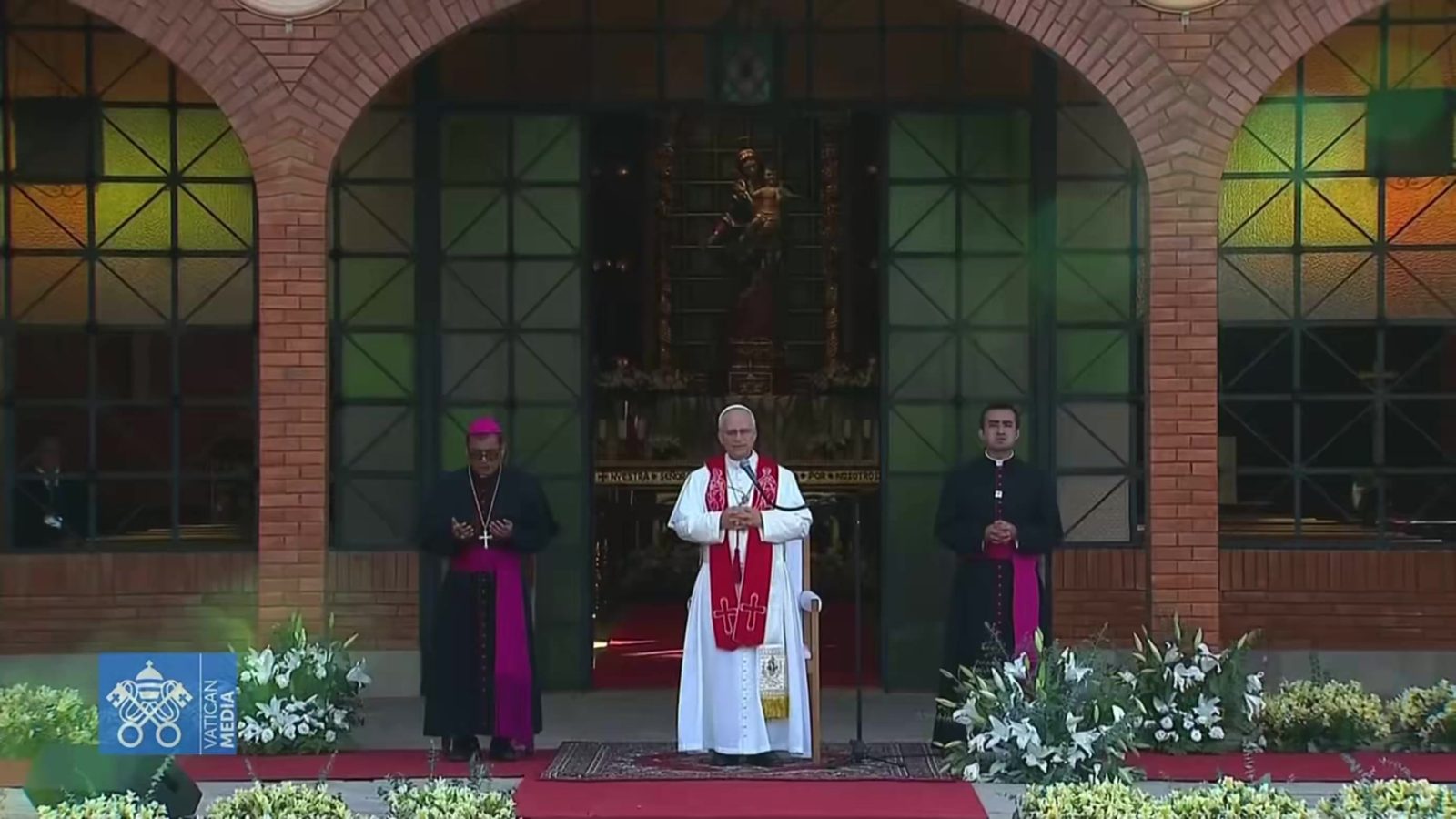
"Before any service, office, profession or ministry, we are baptized. Our primary identity is that of sons and daughters of God and members of his chosen people." Leo XIV said this on Friday, 13 November, at the Shrine of Our Lady of Peace in Chiclayo, meeting bishops, priests, deacons, men and women religious, seminarians, synodal teams and pastoral councils from the diocese and from various regions of Peru. In the Church he led as bishop from 2015 to 2023, the Pope asked: "How can we become a more synodal and missionary Church?" The Pope spoke in Spanish; quotes follow the English translation published by Vatican News where available, otherwise they are our translation of the official Spanish text released by the Holy See Press Office.
The official account. According to the Holy See Press Office bulletin (B0913), the Pope left the Bishop's House at 4:15 p.m. local time (10:15 p.m. in Rome) and began the meeting at the Shrine at 4:30 p.m. Welcomed by the rector, Fr José Antonio Jacinto Fiestas, he crossed the square in front of the Shrine with him and entered for a brief moment of recollection before the Blessed Sacrament, during which he presented the Golden Rose. He then went to the stage set up outside. After a welcome from the Bishop of Chiclayo, Bishop Edinson Edgardo Farfán Córdova, and testimonies from a priest, a religious sister of the Archdiocese of Trujillo and a laywoman of the Archdiocese of Piura, the Pope delivered his address. Some 5,000 people took part, inside the Shrine, in the square and in the surrounding streets.
Baptism comes first. At the heart of the address was our bond with Christ, "rooted in Baptism" (our translation). "Through Baptism, we are incorporated into Christ, made children of God, members of the Catholic Church and sharers in Her mission," the Pope said. Hence everyone's shared responsibility: "the whole community is co-responsible for evangelization" (our translation). Baptism, he added, "is a permanent vocation to listen to the Word, celebrate the faith, live charity, take part in the community, proclaim the Gospel and serve especially the poor and the excluded" (our translation).
"Communion must precede mission." "The first witness that any Christian community must give is the fraternal love that exists among its members, thereby reflecting the Most Holy Trinity. For this reason, communion must precede mission," Leo XIV said. The communion of the Church "is not uniformity," he went on: "Authentic communion values the diversity of cultures, vocations, charisms and ministries as a richness and promotes it" (our translation). Authority within the Church must therefore be exercised as service, discernment and appreciation of charisms and initiatives, "since the participation of the laity is not a concession but an expression of their baptismal dignity."
Tasks that are "not optional." A synodal Church, the Pope said, recalling the Second Vatican Council's Gaudium et spes, shares "the joys, hopes, griefs and anxieties of humanity, especially of the poor and those who suffer" (our translation). Listening to social and cultural realities, defending human dignity, accompanying families, young people, migrants, indigenous peoples and people living in poverty, and working for justice, peace and the common good "are not optional tasks; they are requirements of our ecclesial mission" (our translation).
Walking together. Synodality, "promoted with great enthusiasm by Pope Francis," means "walking together, listening, discerning and taking part in the mission with shared responsibility" (our translation). "'Synodality' expresses the idea of walking together. It is a fundamental dimension of the Church, which expresses the identity of the people of God as pilgrims and as an assembly called together by the risen Lord." The Pope encouraged those present "to discover ever more the beauty of being synodal communities" (our translation), with everyone offering their own contribution "like living stones of a spiritual building" (our translation). This requires a spirituality founded on prayer, listening to the Word, participation in Mass, Eucharistic Adoration, fraternal dialogue and communal discernment. "It is a communal and pastoral way of life that must be interiorized so that it can be coherently put into practice." And he warned: "Indeed, it is easy to speak about synodality, but putting it into practice is a challenge and requires everyone to examine their attitudes and conduct, beginning with the pastors, who are the primary servants of the community."
A pastoral council in every community. "For dioceses and parishes to be able to adopt this synodal style of communion, participation and mission, it is worth revitalizing the role of pastoral councils," the Pope said. "Although their input is consultative, their ecclesial importance is considerable: they help the community to listen, understand reality, discern priorities and formulate more appropriate responses." He urged that "every community be able to count on its own pastoral council, whose members also commit to receiving suitable formation" (our translation).
The Our Father and the bell. In closing, the Pope thanked those present for their generous dedication to the cause of the Gospel and prayed that Our Lady of Peace bless their efforts "to ensure that the Kingdom of God takes root in this northern land and bears abundant fruit for the glory of God and the good of souls." Before the Our Father, prayed together, he added: "We must live this dimension of prayer so as to be always united to Christ" (our translation). After the blessing and a gift to the Pope, Leo XIV greeted a group and blessed a liturgical bell made in France for the Apostolic Visit to the Shrine of Our Lady of Peace and Saint Joseph. He then moved on to the Santo Toribio de Mogrovejo Catholic University for the meeting with the university community.
What we don't know. The official Italian and English translations of the address are not yet available: for now the text has been published only in Spanish. This article will be updated when they are released.
Sources: Holy See Press Office bulletin B0913, text of the address, The Holy See, original Spanish text, Vatican News (English), Vatican Media.
#LeoXIV #Vatican
Source: Sala Stampa della Santa Sede
Everything on the journey: programme, Vatican Media live stream and live updates
Follow the journey →