
APOSTOLIC JOURNEY · URUGUAY · ARGENTINA · PERU
LEO XIV · NOVEMBER 6-17, 2026
“Two Popes, one by adoption”: the deleted post and the reaction in Argentina
The line is not in the official Luján text. The Holy See has yet to offer an explanation. In Argentina, newspapers and commentators are asking why the post disappeared.
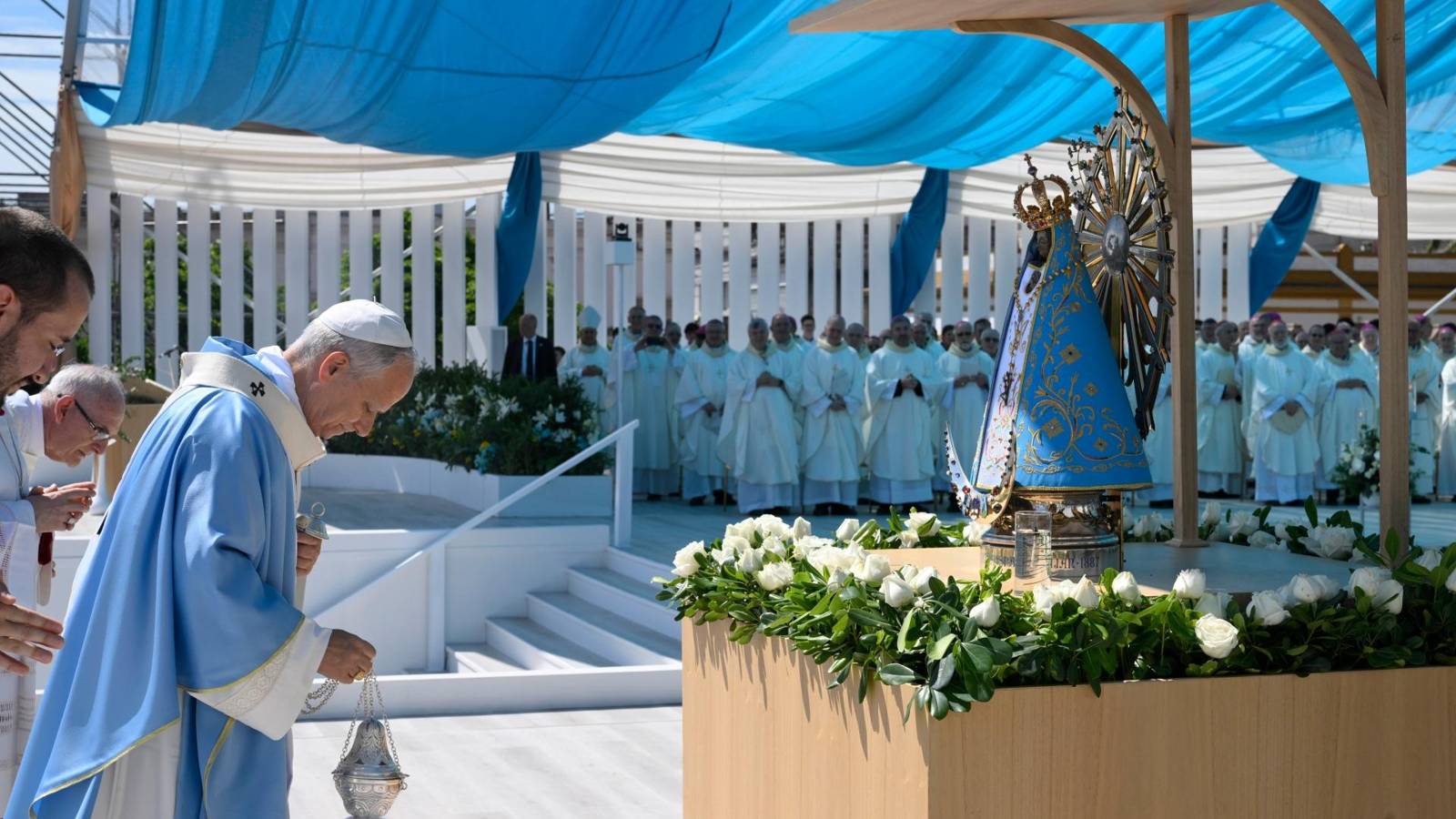
Sometime overnight between 11 and 12 November, after Leo XIV had already arrived in Peru, the farewell message posted on the official account @Pontifex_es disappeared from X. According to La Nación, the same happened on Instagram. The text, published at 2:19 p.m. Argentine time (6:19 p.m. in Rome) on 11 November, thanked the country for its welcome and closed with a line that had already travelled widely: “pueden decir que este país desde ahora tiene dos Papas: uno que ha nacido aquí y otro por adopción” — “you may say that from now on this country has two Popes: one who was born here and another by adoption.”
La Nación reported that the post remained visible for at least six hours. It was then taken down. As of the afternoon of 12 November in Rome, the Holy See has still issued no official explanation.
The official text and the omitted line. In the Pope’s final words of thanks at the Mass in Luján, published in the Holy See Press Office Bulletin (B0900/01664), the sentence about “two Popes” does not appear. After saying that he had felt “at home,” the Pope moves straight to “Let us remain united in Christ” and to the closing “Farewell, my dear Argentina!”
The specialist site Silere non possum has offered this reconstruction: the line was in the text prepared in advance and given to journalists, but the Pope chose not to say it when he took his leave. Vatican News and then @Pontifex_es published it anyway; the article was later replaced and the post deleted. That is a third-party reconstruction, not a Holy See statement. In Argentina it was also taken up by A24.
How the Argentine press has told the story. The episode occupied a substantial part of the news day in the national media. Clarín framed the withdrawal as a “change of heart” and reported that, before it vanished, the message “había pasado holgadamente los 200 mil likes” — it had comfortably passed 200,000 likes. The same newspaper suggested, in the conditional, that the Pope’s communications team may have judged it excessive for a head of state who already holds American and Peruvian citizenship to declare a “new nationality” in those terms. That is not an official explanation, and it has not been confirmed in Rome.
La Nación wrote that, “hasta el momento, se desconocen las razones” — for now, the reasons are unknown. In a later passage, Vatican sources told the paper that there had been an “internal mismatch” in the Dicastery for Communication, and that the matter might be raised with the Pope on the return flight to Rome. That, too, is an on-background remark, not a communiqué.
Infobae, on 11 November, had published the message as an official farewell, before it was withdrawn, presenting it as the greeting the Pope left before continuing to Peru. A Página/12 piece on this specific episode has not, so far, come to light.
Commentators and the debate online. On Radio Mitre’s programme Alguien tiene que decirlo, Eduardo Feinmann spoke, in the conditional, of an “apparent diplomatic friction” (“roce diplomático aparentemente”) in the Holy See, and added that, in his view, Vatican diplomacy would avoid showing “tanto favoritismo por un país.” That is a commentator’s thesis; the Holy See has not confirmed it. Feinmann has also said that the line “estaba escrito, pero no lo dijo” — it was written, but the Pope did not say it — which is consistent with Silere non possum’s reconstruction.
TN recorded the surprise and the debate among users: some asked why a message they called “hermoso” had been deleted; others said that, whatever happened to the post, the country still felt “adopted.” Noticias / Perfil noted that there is still no conclusive institutional account of who ordered the withdrawal, or of the definitive reason.
What we do not know. So far there has been no public statement from the Argentine government or from the local Church specifically about the removal of the post. President Javier Milei greeted the Pope at Ezeiza airport before departure with words of affection — “Esta es su casa; lo esperamos” — but that gesture came before the deletion and is not a reaction to it. The central question remains: why a line that had been prepared, was not spoken in Luján, and was nonetheless posted online was later taken down, and who decided that. Until the Holy See issues a note, the answers in circulation are still hypotheses.
Sources: Holy See Press Office, Bulletin B0900 of 11 November 2026 (final thanks); Silere non possum; La Nación; Clarín; Infobae; Radio Mitre; TN; Noticias / Perfil; A24.
#LeoXIV #Vatican
Source: Sala Stampa della Santa Sede e stampa argentina
Everything on the journey: programme, Vatican Media live stream and live updates
Follow the journey →