

Leo XIV, a week between the table of the poor and the invisible of Rome
From the Angelus of Christ the King and lunch with 1,300 of the poor in the Paul VI Hall to the first Advent visit at Sant’Andrea delle Fratte.
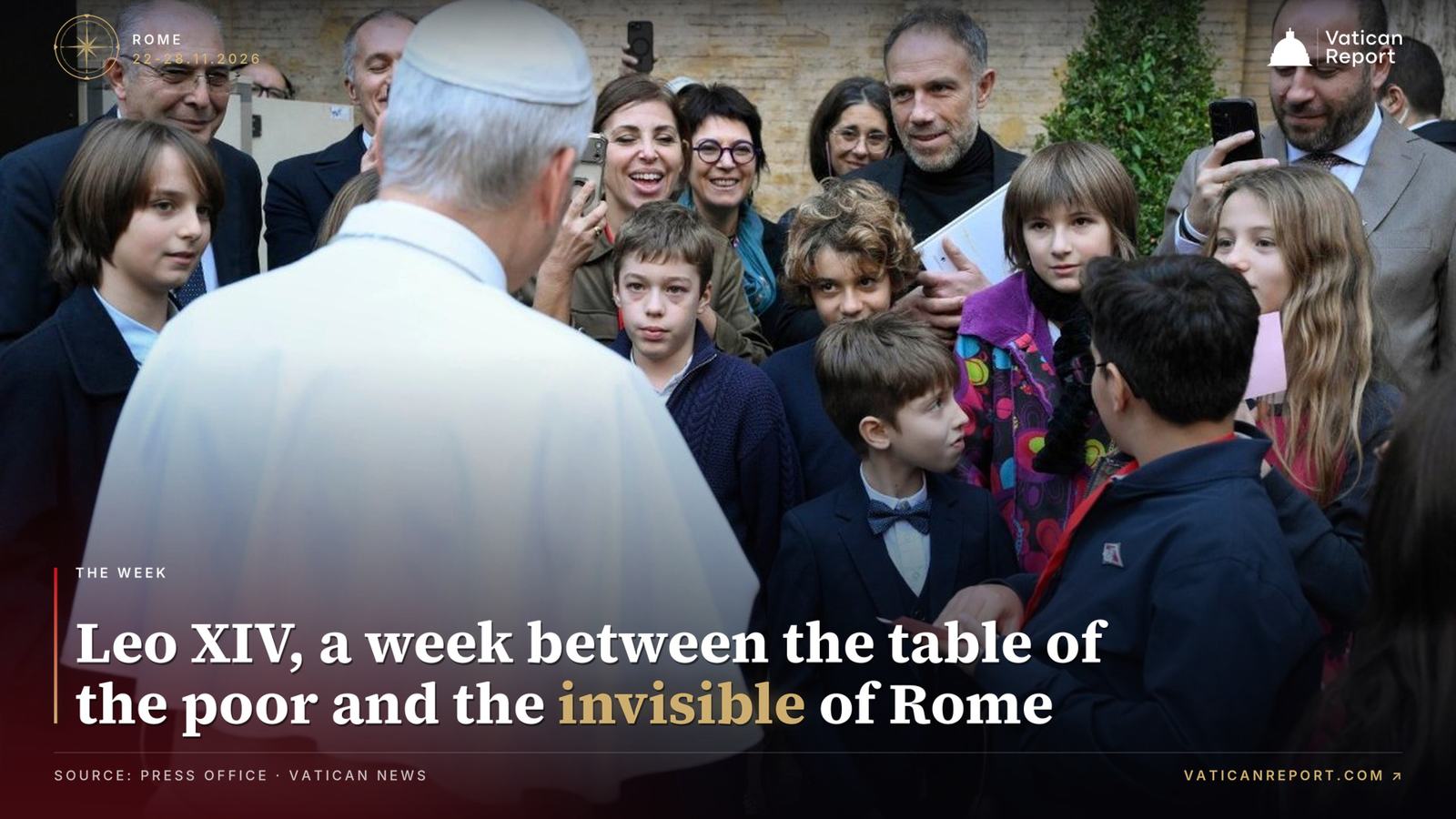
From the Angelus of Christ the King and lunch with 1,300 of the poor in the Paul VI Hall to the first Advent visit at Sant’Andrea delle Fratte, Leo XIV held together justice, charity and disarmament. The week also saw the publication of Pope Francis’s Personal Diary, the Motu Proprio on prison ministry, the Pope’s warning against the arms race and the militarization of artificial intelligence, and the final statement of the Italian bishops’ assembly in Assisi. Tomorrow, the First Sunday of Advent, the Pope will be at San Carlo da Sezze, on the Acilia outskirts of Rome.
At Sant’Andrea delle Fratte, the invisible around the “banquet table”. On Friday 27 November, the feast of Our Lady of the Miraculous Medal, Leo XIV opened his five Advent visits to the parishes of Rome in the basilica of Sant’Andrea delle Fratte, the “Roman Lourdes”, as Benedict XV called it.
He arrived at around 4 pm and was welcomed by the Cardinal Vicar, Baldo Reina; he offered flowers to Our Lady of the Miracle, met parish groups and the pastoral council, and recited the Supplication to the Virgin. At 5 pm he presided over Mass: coming “as a pilgrim” at a time “marked by wars and unjust inequalities”, he said that “conversion, even before being a change of life, is a change of mentality”, and asked the parish to serve the neediest so that the beauty of the place may become “a faith that becomes charity”.
In his homily the Pope described the historic centre of Rome as “a banquet table” around which there remain invisible the poor sleeping on the streets, elderly people left alone, foreigners, and workers “with wages that wound their dignity”. After the Salve Regina and a greeting to the faithful outside the shrine, he left the parish at about 6.45 pm (Bulletin B0962; Vatican News; our article).
Christ the King: justice, measured at table with the poor. On Sunday 22 November, the last Sunday of the liturgical year and the Solemnity of Christ the King, Leo XIV reflected at the Angelus, from the window of the Apostolic Palace, on the Gospel of the Last Judgment (Mt 25:31-46). Christ is “the measure of justice”; the King of the universe “stands alongside the least and the oppressed”. The One who speaks “is neither a despot who threatens nor a tyrant who crushes others with his power”, but “the true King” who redeems us. Recalling Pius XI, he said the Lord of history is “the King of peace and justice for all the peoples of the world” (B0942).
After the prayer, as dioceses celebrated World Youth Day, he gave young people the theme of Seoul 2027, “Take courage! I have overcome the world” (Jn 16:33). He expressed his closeness to the people of Papua New Guinea and other Pacific countries affected by drought, and asked for prayers for the victims of conflicts and for those responsible, “that they may commit to finding solutions for reconciliation and peace without delay”.
Shortly afterwards he turned those words into a gesture: in the Paul VI Hall he sat down with 1,300 of Rome’s poor for the tenth World Day of the Poor, a lunch organised by the Dicastery for the Service of Charity with the Italian Red Cross and moved back a week because of the apostolic journey. Before the blessing he said: “We are all family today.” At the Angelus he had asked that the lunch be “a sign of a way of life to be embraced every day: a way of fraternal sharing that leaves no one alone in their time of need” (B0944; our article on the Angelus).
The arms race, AI and “integral disarmament”. On Wednesday 25, in St Peter’s Square, the General Audience continued the cycle on the documents of the Second Vatican Council with chapter V of Gaudium et spes. Quoting his encyclical Magnifica humanitas on the new “hybrid forms” of war, Leo XIV reaffirmed that “the arms race is one of the greatest curses on the human race and harms the poor to an intolerable degree” (GS 81): words that today are “the very cry rising to the powerful of the world from the suffering of peoples, of children killed and maimed, of families destroyed”. The Council, he explained, does not deny governments “the right to legitimate defence”, but calls for international bodies able to intervene. In his closing appeal he noted that COP31 in Antalya had ended “without the international community adopting clear commitments” on the climate: “Let us never forget the human face of the climate crisis” (B0951).
On Thursday 26, in the Consistory Hall, receiving participants in the 15th Plenary Assembly of the Dicastery for Interreligious Dialogue, he warned that peace is also threatened by “technological progress that favours the militarization of artificial intelligence, entrusting machines more and more with decisions concerning life and death”. “Integral disarmament” must be rediscovered: it “cannot be achieved only through political agreements or the mere reduction of weapons” and “requires a profound transformation of hearts and minds” (B0954). To the Dicastery for Promoting Integral Human Development, in the Clementine Hall, he said: “The Gospel is not a social programme, but neither is it an experience lived outside history. In Christ there are not two missions, one spiritual and one social” (B0955).
Pope Francis’s Personal Diary. On Tuesday 24 the Vatican Publishing House released Il Diario personale di Papa Francesco, edited by Cardinal Víctor Manuel Fernández: notes from 20 December 1992 to 18 August 2024, some written in the diary he kept at Casa Santa Marta. It was Leo XIV who found the box of notebooks and authorised publication; Francis had asked Fernández to use “whatever may serve for edification”. The book appeared in five languages and 94 countries; it is not the complete diary: passages concerning living persons were left out.
The pages reveal a spiritual crisis in 2021-2022, “dryness, desolation, a dark time”, which according to the editor ended at Christmas 2022 and gave rise to C’est la confiance and Dilexit nos. Francis records “three certain episodes” in which the devil presented himself physically and, on 30 December 2022: “Jorge arrogant, self-sufficient, cynical and a liar about himself…”. Fernández told Corriere della Sera: “Pope Francis was a mystic.” The volume also reports Francis’s judgement on Robert Francis Prevost, today Leo XIV: “a great pastor, a generous missionary and an irreproachable man.”
On 25 November, the day after publication, the Bulletin recorded that the Pope had received Cardinal Fernández, prefect of the Dicastery for the Doctrine of the Faith, without adding further details (B0957). The book’s presentation is scheduled for Saturday 28 November at 5 pm at San Fedele in Milan, for BookCity (Vatican News; ANSA; Corriere della Sera).
To the superiors general: to lead is to serve. On Thursday 26, in the Synod Hall, Leo XIV met more than 250 superiors general attending the second joint UISG-USG Assembly, under way at the Fraterna Domus in Sacrofano on “unarmed and disarming” leadership. Observing that the Church needs consecrated life, he opened a spontaneous dialogue. Recalling St Augustine, superiors should not consider themselves happy because they exercise power, but because they serve in charity: “If we want to create unity, let us serve with charity,” with particular care for those who are fragile or difficult. He presented chastity, poverty and obedience as instruments of healing in a society marked by possessiveness, and synodality as moving “from the ‘I’ to the ‘we’”. The text of the dialogue was published by the Press Office (B0956).
On Friday, in Sacrofano, the assembly closed: among the proposals, Sister Priscilla Latela told Vatican News, are a jubilee year for peace and a letter to heads of state.
In Assisi, the Italian bishops: abuse, end of life, a national tribunal. From 23 to 26 November the 83rd General Assembly of the Italian Bishops’ Conference met in Assisi, under Cardinal Matteo Zuppi. At the opening Zuppi announced the pilot study on abuse by clerics in Italy, reported and handled by diocesan Ordinaries between 2001 and 2021: “The victims remain at the centre: their pain, their demand for truth and justice.”
On Wednesday 25 the study, entrusted to the University of Bologna and the Istituto degli Innocenti in Florence, was presented: 378 reports analysed of alleged or proven abuse of minors by clerics, received by dioceses between 2001 and 2021, with 385 alleged victims, mostly adolescent boys; 198 of 226 dioceses took part. It is not an estimate of the phenomenon but an analysis of reported cases. Zuppi spoke of “an open wound in the body of the Church”: “We are ashamed of it and do not want to hide it”; the study is “a first step, not a point of arrival”. The Assembly unanimously approved eight lines of action, including a national observatory and a national interdiocesan criminal tribunal.
In their final statement the bishops say that “there is no ‘right to die’, but the right to be cared for, assisted and never left alone”, and call for the gap in palliative care, home care and hospices to be closed (Vatican News; CEI; SIR).
The Motu Proprio on prison ministry, and the wish to visit a prison in Rome. On Wednesday 25 the Motu Proprio In carcere eram, et venistis ad me, dated 22 November, was published. It suppresses the International Commission of Catholic Prison Pastoral Care and establishes, within the Dicastery for Promoting Integral Human Development, the Service for the animation of prison ministry, coordinated by a bishop appointed for five years. The first Coordinator is Archbishop Jorge Ignacio García Cuerva of Buenos Aires (B0952, B0953).
On Thursday 26 the Cardinal Vicar, Baldo Reina, said the Pope “has expressed the wish to visit one of the detention facilities in the city”, without giving a date (Avvenire).
The telegram for Cairo, and other Holy See developments. On Friday 27, in a telegram signed by the Cardinal Secretary of State, Pietro Parolin, Leo XIV expressed his condolences for the victims of the fuel tanker fire on the Cairo ring road, where 31 people had died on Wednesday evening, commending “the souls of the deceased to the great mercy of the Almighty” (B0960; Vatican News).
The same day the Dicastery for Promoting Integral Human Development announced the theme chosen by the Pope for the 2027 Lenten Message: “Let us embrace fragility”, linked to the encyclical Magnifica humanitas (B0961). A decree of the Dicasteries for Consecrated Life and for Laity, Family and Life appointed three pontifical commissioners for the Heralds of the Gospel and its two related societies — Msgr Lucio Nicoletto, Sister Ana Teresa Pinto, FMA, and Father Siro Stocchetti — after the resignation of Cardinal Raymundo Damasceno Assis, commissioner since 2019. The Holy See also confirmed Tiziano Onesti as president of the Bambino Gesù Children’s Hospital for three more years.
On 24 November the Bulletin published the calendar of celebrations Leo XIV will preside over in December and January: on 24 December at 10 pm Midnight Mass in St Peter’s; on the 25th at 10 am Mass during the Day and at noon the Urbi et Orbi blessing; on 31 December at 5 pm First Vespers and the Te Deum; on 1 January at 10 am Mass for the 60th World Day of Peace; on 6 January at 10 am the Epiphany; on 10 January at 9.30 am, in the Sistine Chapel, Mass with the baptism of some children (B0948).
On 26 November the IOR announced that a Budapest court had revoked, in a ruling that cannot be appealed, its 21 October order requiring the Institute to pay 20 million euros in the case of the former Stock Exchange building: first-instance proceedings can now begin. The same day Cardinal Parolin blessed in the Vatican Gardens a red viburnum (kalyna), a gift from Ukraine to Leo XIV, opened the academic year of the Pontifical Lateran University with President Sergio Mattarella, and celebrated at St John Lateran a Mass for the victims of the Holodomor, calling for “a just, authentic and lasting peace”.
Among other audiences and addresses this week: on Monday 23 the Pope received about 120 athletes and leaders of world cycling, saying that the bicycle “can even be an instrument of evangelisation” (B0946), and the benefactors of the new Swiss Guard barracks (B0945); on Wednesday 25 he told the International Theological Commission that sacred Tradition is “always alive” and that growth in understanding “does not imply a rupture in the teaching of the Magisterium” (B0950); on Friday 27, to the chaplains of the Italian Sports Centre (CSI), he presented sport as an antidote to the isolation of young people (B0958).
Appointments in the Bulletin. In this week’s Bulletins: the resignation of Gerhard Feige as bishop of Magdeburg, Germany (22 November, B0943); the resignation of Thomas Aquinas Lephonse from Coimbatore, India (24 November, B0949); in Sion, Switzerland, the resignation of Jean-Marie Lovey and the appointment of Alain de Raemy, with Mauro-Giuseppe Lepori, O.Cist., named bishop of Lugano; Gabriel Marcelo Viola Casalongüe named Head of Protocol of the Secretariat of State (25 November, B0952); the resignation of Theodore Mascarenhas from Daltonganj, India (26 November, B0957). The Bulletin of 27 November reported no appointments.
What to expect next week. Sunday 29 November is the First Sunday of Advent. At noon, the Angelus in St Peter’s Square; at 4 pm Leo XIV arrives at the parish of San Carlo da Sezze, in Acilia, in the southern outskirts of Rome, the second of his pastoral visits: meetings with catechism groups, young people and the pastoral council, and Mass at 5 pm (Diocese of Rome; vatican.va calendar). The parish, opened in 1987, serves a community of 18,000 people.
On Monday 30 November St Peter’s Basilica will be closed to the public from 9.30 am to 1 pm. On Wednesday 2 December, at 10 am, the General Audience. Looking further ahead, the already published calendar provides for Mass on the Second Sunday of Advent, 6 December, in a parish of the eastern sector, and on 8 December the act of veneration of the Immaculate Conception.
Sources: Holy See Press Office (Bulletins B0942–B0962); Vatican News; CEI; SIR; Diocese of Rome; Leo XIV’s activities calendar on vatican.va; Avvenire; ANSA; Corriere della Sera; IOR statement. The Bulletin of 28 November had not yet been published at the time of writing.
#LeoXIV #Vatican
Source: Sala Stampa della Santa Sede, Vatican News