APOSTOLIC JOURNEY · URUGUAY · ARGENTINA · PERU
LEO XIV · NOVEMBER 6-17, 2026
Leo XIV to Chiclayo's university world: “Limitation is not a manufacturing defect, but rather the very condition of human grandeur”
At the university he once served as Grand Chancellor, the Pope warns against the promises of transhumanism and posthumanism: progress is not “a privilege for millionaires who aspire to immortality”
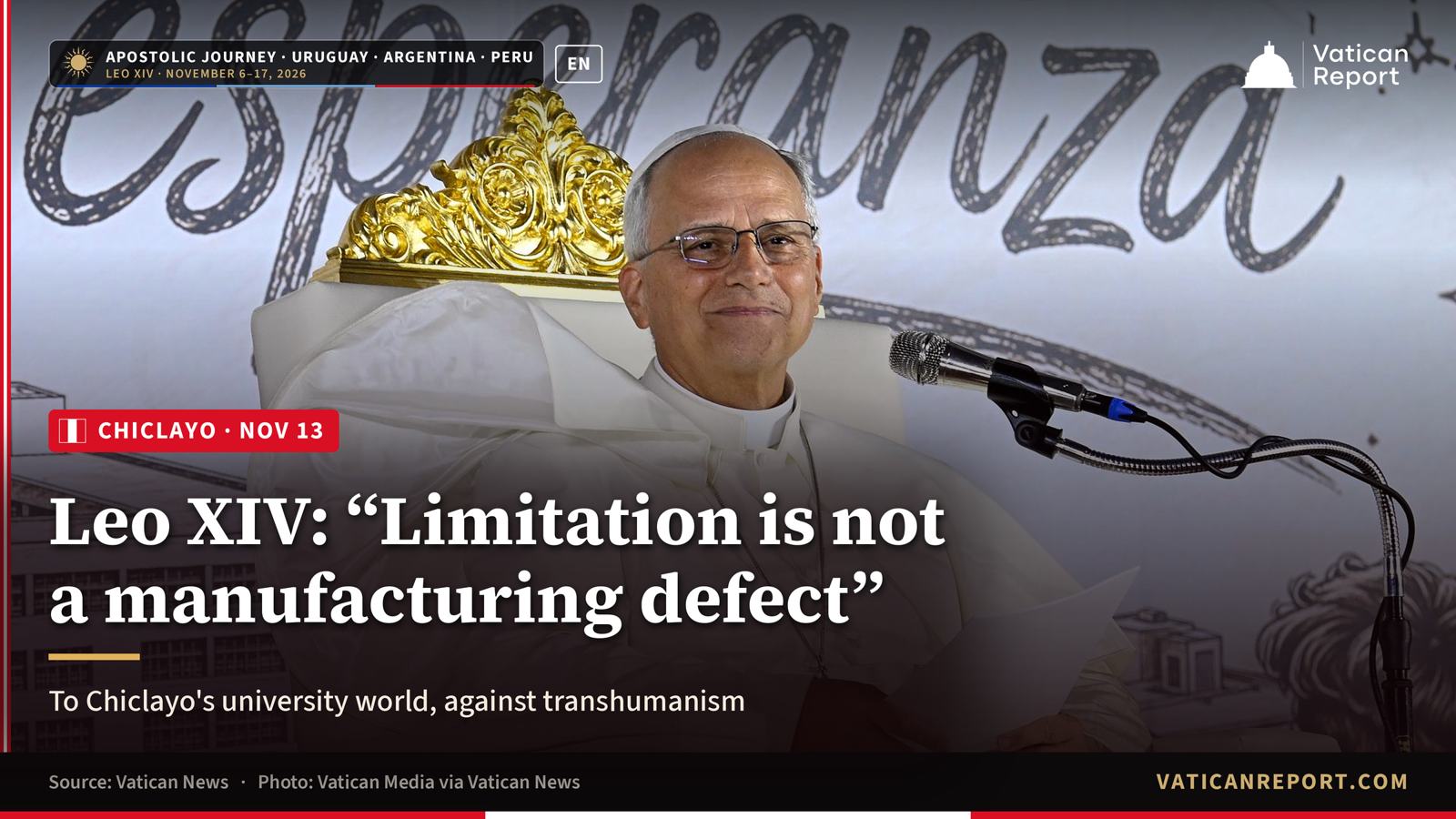
“Limitation is not a manufacturing defect, but rather the very condition of human grandeur.” With these words Leo XIV answered the promises of transhumanism and posthumanism on Friday, November 13, at the Universidad Católica Santo Toribio de Mogrovejo (USAT) in Chiclayo. Before students, professors and academic authorities, some 6,000 people according to the EFE news agency, the Pope returned to the university he served as Grand Chancellor during his years as bishop of Chiclayo, from 2015 to 2023. It was the last public event of a day that began with Mass at the Pampas de Pimentel. Quotes are from the Spanish text of the address released to the press and reported by Vatican News and news agencies; English renderings follow Vatican News where available and are otherwise our translation.
The event. The Pope arrived on campus amid the crowds and rode through the audience in a golf cart before reaching the stage in front of the rectorate, beneath the motto of the meeting, “Diseñando nuevas rutas de esperanza” (Designing new paths of hope). Students welcomed him chanting “¡León, hermano, tú eres chiclayano!” (Leo, brother, you are from Chiclayo!). After testimonies from Ángela, Adriano and Professor Guzmán, which the Pope later took up in his address, Leo XIV spoke.
“Education is a noble act of hope.” “It is a great joy for me to return to Chiclayo and to meet you in this cloister of the Saint Turibius of Mogrovejo Catholic University,” the Pope began, thanking the Lord “for the years he allowed me to share in mission, at the service of the Peruvian people.” He told the university community: “During my years as Grand Chancellor of this institution, you helped me understand that authority is service, that governance is listening, and that education is a noble act of hope.” A university, and a Catholic university in particular, “is a living community where the search for truth becomes an act of love and service to the great human family.”
“Science without conscience ruins everyone's life.” At a time of “complex cultural changes,” the university is called to be “a forge of talents and a laboratory of meaning,” free from “the temptation to produce skilled labor for an exclusive and highly competitive market.” “Progress that is indifferent to justice and to the dignity of workers in fact becomes a mechanism of oppression and exclusion,” the Pope warned. For this reason the Catholic university has “the duty to recall, in the public and political sphere, that science without conscience ruins everyone's life.” He added: “Technology, dear friends, is not always neutral: at times its forms bear the imprint, the interests and the ambitions of those who design and control it.”
The most deadly risk. “The most deadly risk is that of submission to the technocratic paradigm, which reduces reality to material data, with efficiency as its supreme value,” Leo XIV said, asking scholars and students to exercise critical thinking: “Always seek that wisdom that neither machines nor computer programs can possess.” Only in this way, he added, will technological progress be “at the service of our integral development, safeguarding the dignity of every person and promoting the common good.”
Against the promises of transhumanism. The heart of the address was what the Pope called “a central issue in contemporary thought: the human limit.” “Today the promises of transhumanism and posthumanism are multiplying: these are ideological currents according to which, sooner or later, technology will eliminate all disease and pain, as well as aging and even death itself.” Yet, he said, “precisely because progress in the sciences is an excellent fruit of human intelligence, it is not to be confused with a privilege for millionaires who aspire to immortality, while entire peoples suffer misery and oppression. We are thus sold the illusion of human beings optimized by cybernetics and biotechnology. In the face of this mirage, Christian anthropology reminds us that limitation is not a manufacturing defect, but rather the very condition of human grandeur.” Limitation, he continued, “calls us to solidarity and openness to the transcendent”: “while the myth of self-sufficiency locks us into selfishness and leads us to discard the weak, recognizing our fragility makes us attentive to the needs of all.”
The example of Saint Turibius. The Pope pointed to the university's patron, the 16th-century Archbishop of Lima who defended “with evangelical vehemence” the dignity of indigenous peoples, learned their languages and wrote for them one of the first catechisms in the Americas in native languages. “Today, deserts are not only the arid expanses of Lambayeque that the holy pastor crossed on horseback: they are the new moral and civic illiteracies that exclude the poor,” he said. A university modelled on his example “is called to use scientific innovation to bridge social divides and heal society's wounds.” Saint Turibius, too, he recalled, “experienced physical limitation” on his exhausting journeys: “Today it is up to us to renew his example!”
To students and professors. The Pope urged students, the “natives” of this new era, to look at its opportunities “in the light of faith, which is a torch in the confusion and in the darkness of loneliness, boredom and pain.” “Both prayer and study transform our minds to the point of changing our lives.” Taking up Professor Guzmán's testimony, he explained that sacrifice above all “means to make sacred.” To the faculty he said: “Discover, with wonder and passion, that your work is a lofty expression of intellectual charity,” asking them to be “free thinkers, for whom truth comes before opinion, and justice before self-interest,” and to translate their scientific expertise “into works of social justice, especially for the benefit of the poorest, and in the care of creation.” He closed by entrusting the university to the Virgin Mary, Seat of Wisdom.
What we don't know. The official text of the address has not yet been published on the Holy See's website or in the Press Office bulletin, and official Italian and English translations are not yet available: quotes follow the Spanish text released to the press and reported by Vatican News and news agencies. This article will be updated when the official text is available.
Sources: Vatican News (Spanish), Vatican News (English), Infobae, text of the address, EFE via ABC Color, Vatican Media.
#LeoXIV #Vatican
Source: Vatican News
Everything on the journey: programme, Vatican Media live stream and live updates
Follow the journey →